
How to Scale a Tour Operation from 10 to 100 Bookings a Month
Manual processes that work at 10 bookings a month break at 20, 40 and 80. Here is where Sri Lankan DMCs hit the wall, the six systems that get them past it, and a realistic rollout order.
Travify Team
Travel Operations Experts · April 13, 2026 · Updated October 6, 2026
In short: Scaling a tour operation from 10 to 100 bookings a month means handling more volume without adding staff, errors or firefighting in proportion. Manual processes break at predictable points, around 20, 40 and 80 bookings. The fix is six systems: centralized booking management, an expense catalog, tour templates with costing duplication, department roles with markets, an audit log and reports, rolled out in sequence over about 12 months.
A DMC (destination management company) is the inbound tour operator that builds, prices and runs the ground arrangements for travelers arriving in Sri Lanka. Sri Lanka recorded 2.36 million arrivals in 2025, a 15.1% rise on the previous year, and the government is targeting 3 million in 2026. For a Sri Lankan DMC, that is the opportunity of a decade.
The uncomfortable part: the manual processes that got you to 10 or 20 bookings a month will not get you to 50, let alone 100. The 2026 operator outlook covers demand; this guide covers operations.
Key takeaways
- Manual tour operations hit predictable walls at roughly 20, 40 and 80 bookings a month: first missed follow-ups, then an owner bottleneck, then permanent firefighting.
- Hiring more people to run the same manual process raises payroll and coordination overhead without lowering the error rate per person.
- Six systems carry a DMC past 100 bookings: centralized booking management, an expense catalog, tour templates with costing duplication, department roles with markets, an audit log and built-in reports.
- Roll the systems out in sequence over about 12 months, starting with new bookings only, ideally during the May to September low season.
- Role-based, market-scoped access is what keeps a shared booking list usable once nobody on the team can see everything.
Where do manual tour operations break as bookings grow?
Manual tour operations break at three predictable points: around 20 bookings a month, around 40, and at 80 or more. Each wall has recognizable symptoms you can prepare for.
Breaking point 1: the 20-booking wall
At around 20 active bookings a month, the owner or lead operator can no longer hold every detail in their head. The symptoms: bookings that fall through the cracks because nobody followed up, duplicate work because two people unknowingly handle the same inquiry, and inconsistent pricing because different staff quote different rates for the same hotel.
Breaking point 2: the 40-booking chaos zone
At 40 bookings a month you have probably hired more staff, but without systems, more people means more coordination overhead. The owner becomes the bottleneck: approving every costing, answering every hotel-rate question, checking every voucher. Email chains sprawl, handoffs from sales to operations to accounts drop information, and errors that were occasional at 10 bookings become systemic at 40.
Breaking point 3: the 80-plus booking crisis
At 80 or more bookings a month, a manual operation lives in permanent emergency. Every December to March peak feels like a survival exercise, staff burn out, and personalization suffers because the team is stretched too thin. Financial tracking becomes so tangled that you do not know which bookings were profitable until weeks after the guests depart, if ever. See how to handle the December to March peak.
| Monthly bookings | Typical manual-process symptoms | Usual team response | The real fix |
|---|---|---|---|
| 10-20 | Occasional missed follow-ups, inconsistent quotes | Owner works longer hours | Centralized booking management |
| 20-40 | Duplicate work, information silos, pricing errors | Hire more staff | Standard cost items, tour templates and costing duplication |
| 40-60 | Owner bottleneck, handoff failures, financial blind spots | More hiring, more meetings | Role-based access and delegation |
| 60-100 | Systemic errors, staff burnout, margin erosion | Accept lower margins as "the cost of growth" | End-to-end workflow with audit trails and reports |
The most dangerous response to scaling pain is hiring more people to execute the same broken processes. You end up with higher costs, the same error rate per person, and a management layer that spends its time coordinating instead of growing the business.
What six systems does a tour operator need to scale?
A tour operator needs six systems to scale: centralized booking management, an expense catalog, tour templates with costing duplication, role-based team access, an audit log and built-in reporting. Each removes one specific source of friction, and the gains compound.
1. Centralized booking management
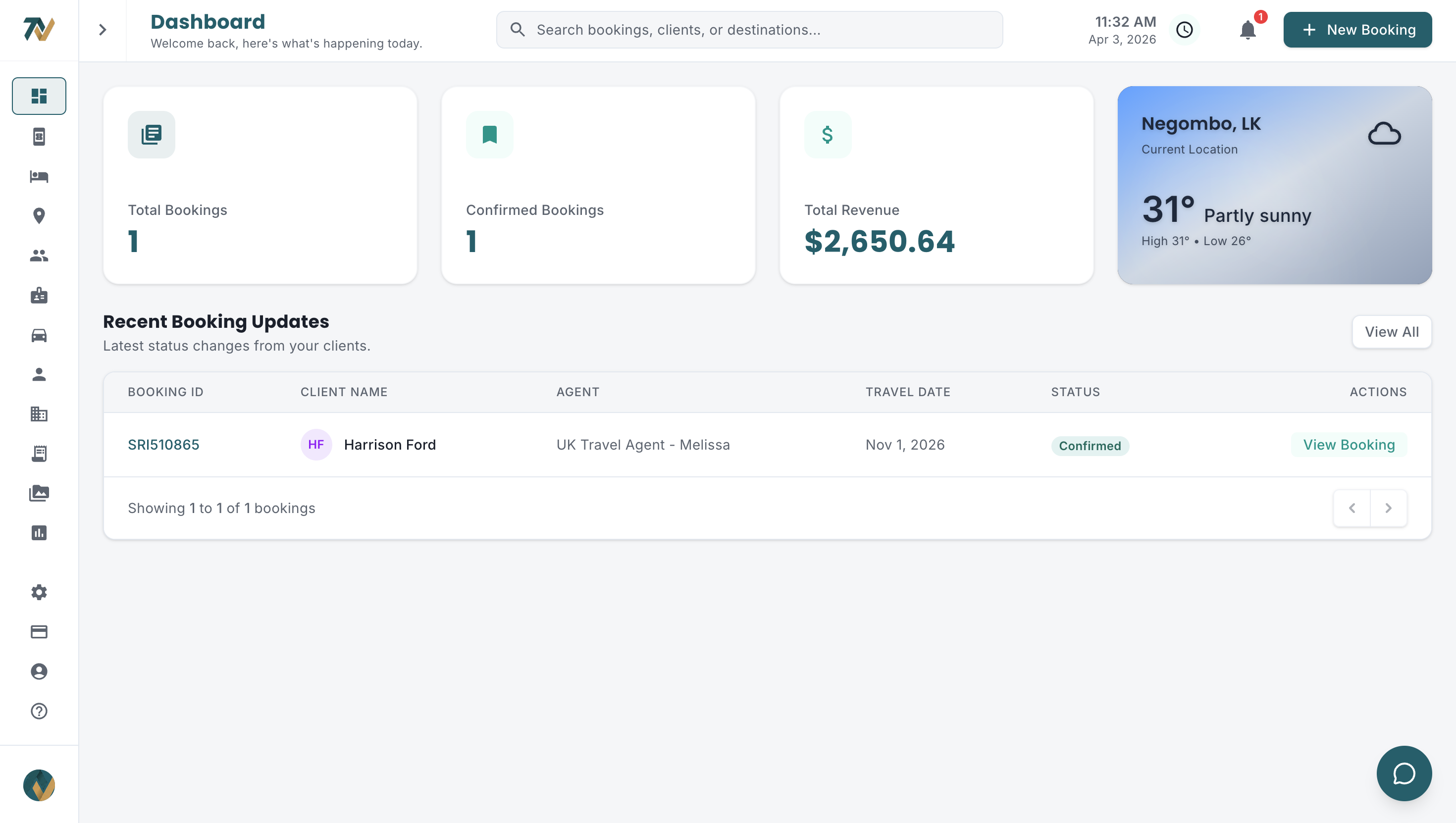
At scale, every booking needs one home that holds its full history, current status and every associated document. Any team member should find any booking by client name, reference, travel dates or travel agent in seconds, without hunting through email threads or asking a colleague.
The capabilities that matter: search and filtering by status, date range and agent; a visible pipeline of stages (inquiry, confirmed, paid, in progress, completed); and a view of upcoming arrivals so operations can plan ahead.
2. Reusable cost items (an expense catalog)
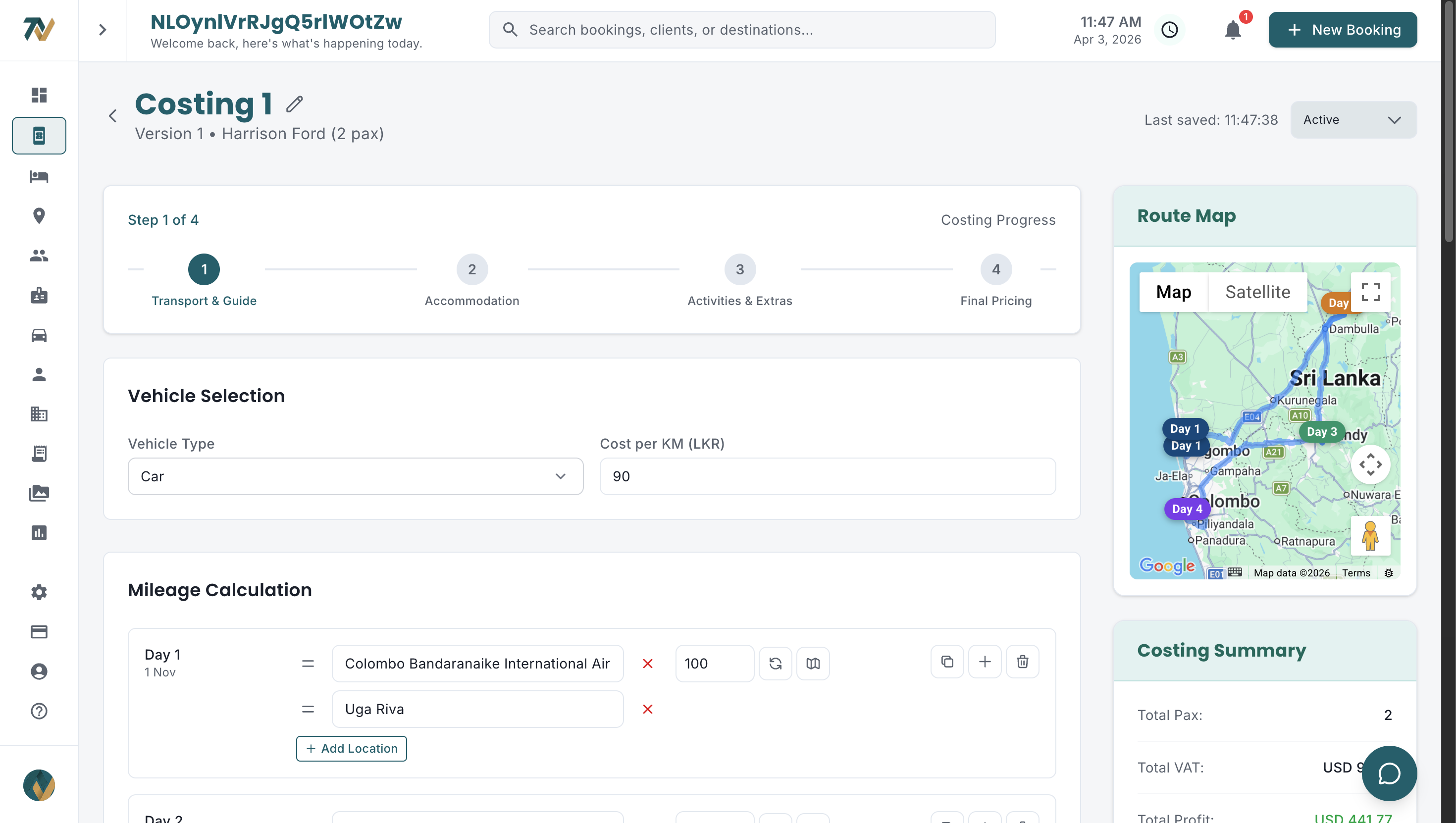
An expense catalog is a library of standard cost items, such as a Colombo to Kandy transfer, Sigiriya tickets or a Yala National Park jeep safari, each defined once with a default rate. Re-typing those costs from memory for every costing wastes hours every week and introduces variation; with a catalog, the designer simply picks the item.
The benefit compounds: every costing uses the same rate for the same park entrance or excursion. If you still build costings in spreadsheets, here is why Excel breaks down at volume.
You do not need to catalog every cost item on day one. Start with the items that appear in most of your costings: common transfers, popular excursion tickets, standard guide fees and frequent activity costs. Add the rest as you meet them in daily work.
3. Tour templates and costing duplication
Most Sri Lankan DMCs sell a handful of signature itineraries, such as a 7-day Cultural Triangle tour, a 10-day island highlights tour or a 5-day wildlife circuit, that are customized per client but start from the same base.
Tour templates and costing duplication turn signature tours into starting points. In Travify, Tours & Contracts holds each tour package with its saved template costings and a day-by-day template itinerary, so a booking linked to the tour starts with that itinerary pre-filled; the designer then duplicates the closest costing, adjusts dates, swaps a hotel if needed, and has a client-ready price in a fraction of the time it takes to build from scratch. Repeat inquiries in peak season are where this saves most. For the method itself, see the complete guide to tour package costing.
4. Team roles, permissions and markets
Once a team passes three or four people, it needs structured access control. A junior coordinator may need to view bookings and create vouchers but not change pricing; a sales designer builds quotations but perhaps should not see cost and margin. Role-based access stops the wrong person editing the wrong record and strips each screen down to what that job needs: less clutter, fewer mistakes, faster work.
The model that fits a growing DMC is departmental rather than one flat ladder, because a transport executive and a finance executive need different things at the same seniority. In Travify, each member is an Admin or belongs to one department (Travels, Transport, Procurement or Finance) with a job title, and the title sets the access level: managers manage, senior roles edit all records, junior roles edit only their own, and trainees view. One person can be fine-tuned without disturbing everyone who shares the title.
Travels members also carry markets, the sales regions they cover, such as Europe, Middle East or South Asia, plus any custom regions your company defines. A designer without a manager title sees and edits only bookings tagged to their markets. That single mechanism keeps a shared booking list usable as you scale: at 20 bookings a month everyone can see everything; at 100 nobody should have to.
5. Audit logging and accountability
An audit log records who changed what, and when, on every booking. Audit logs are not about blame; they are about learning, preventing recurrence and protecting you in disputes with travel agents or suppliers.
An effective trail captures every significant action: booking created, costing modified, voucher generated, invoice sent, payment recorded. When a hotel disputes a rate, you can trace exactly when it was entered and by whom.
6. Reports and analytics for decision-making
At 10 bookings a month you can sense which bookings are profitable and which travel agents send the best business. At 80, you need data. Which source markets carry the highest margin? Which hotels give the best contracted rates relative to your selling price? Which itinerary types convert most often from inquiry to confirmed booking?
Without built-in reporting, those answers take hours of spreadsheet aggregation, so they are rarely produced and decisions on marketing spend, agent relationships and product focus run on gut feel. Reports and analytics for DMC decision-making covers which reports matter first.
What does a realistic 12-month scaling plan look like for a Sri Lankan DMC?
A realistic plan takes a small or mid-size Sri Lankan DMC from about 20 to 80-plus bookings a month over 12 to 18 months, adding one system at a time. Start in the May to September low season so the team learns before the December to March peak.
- Months 1 to 2: set up centralized booking management, move active bookings in, and fix the standard status flow (inquiry, confirmed, paid, in progress, completed).
- Months 2 to 3: build the expense catalog from your most-used cost items and save your signature itineraries as tour templates with their costings.
- Months 3 to 4: load current rate documents for your main hotel partners so contracted rates are picked inside the costing rather than looked up.
- Months 4 to 6: define departments, roles and markets, onboard every team member, and make it a rule that booking activity happens in the system, not in email or WhatsApp.
- Months 6 to 9: use reports to find patterns: which bookings are most profitable, where errors occur, which steps are slowest. Fix the biggest one first.
- Months 9 to 12: with systems carrying the operational load, redirect management time to growth: new travel agent relationships, new products, new markets.
Trying to migrate everything on day one leads to data quality issues and team resistance. Start with new bookings and migrate historical data gradually; the team adopts faster when it sees the system saving time on real, current work.
Why do systems beat headcount when a tour operation scales?
Systems beat headcount because they remove work per booking, while hiring only adds hands to do the same work. The table below is an illustrative comparison, not measured data, of two ways to grow from 20 to 80 bookings a month.
| Metric | Hire more staff (manual) | Implement systems first |
|---|---|---|
| Staff needed for 80 bookings/month | Grows in step with bookings | Grows far more slowly |
| Monthly payroll increase | Several new salaries | One or two targeted hires |
| Average costing time | Long: built from scratch each time | Short: duplicated and adjusted |
| Error rate in costings | Rises with volume and new staff | Stays low: catalog rates, one Active version |
| Quote turnaround time | Often next day or later | Same day |
| Financial visibility | Monthly, after manual reconciliation | Continuous, from live reports |
| Owner time on operations | Most of the working week | A minority of the working week |
| Scalability ceiling | Linear (more bookings = more staff) | Systems absorb the volume |
A systems-first operation handles more volume without a proportional increase in team, and frees the owner and senior staff for business development, supplier negotiation and strategy instead of firefighting. Faster quotes also win more business; see why slow agent replies cost Sri Lankan DMCs bookings.
Sri Lanka's target of 3 million tourist arrivals in 2026 means the pie is growing fast. DMCs that handle more volume per team member will capture a disproportionate share. The question is not whether to invest in systems; it is whether you can afford not to.
What are the common objections to adopting a system, and do they hold up?
The three common objections are size, team resistance and having your own way of working. None of them holds up once the 40-booking chaos zone arrives.
"We are too small to need a system"
Small is the best time to implement one. Setting up systems at 15 bookings a month is far easier than migrating while drowning in 60. Your data is manageable, your team is small enough to train quickly, and you build good habits before bad ones calcify.
"My team will resist changing how they work"
Teams resist when a new system adds work without visible benefit. They do not resist when it removes tasks they find tedious, such as calculating costings by hand, searching for hotel rates or formatting vouchers. Start with the highest-pain workflow, show the time saved, and adoption follows.
"We have our own way of doing things"
Every DMC does, but "our own way" usually means the way you started when you had five bookings a month and have never re-evaluated. Processes should evolve with volume. A good system does not force someone else's workflow on you; it provides structure while accommodating your specific needs.
How does Travify help a Sri Lankan DMC scale?
Travify is web-based travel operations software for Sri Lankan DMCs and inbound tour operators that covers all six systems in one place:
- One booking file per inquiry holds travelers, dates, pax, agent, customer, rooms, flights, payments and special requests, moves from inquiry to completed, and keeps an append-only Change Log of every edit; managers can reassign bookings.
- Email to booking: paste the agent's email or upload a PDF on the New Booking form and AI extracts a structured draft, highlighted for review, instead of a designer re-typing it.
- Costing that reuses what you know: guided multi-step costing with an expense catalog of reusable cost items, one-click duplication, Draft, Active and Archived versions with only one Active, and AI auto-fill that builds the whole costing from the booking and your most similar past costings in one click, or fills it from a typed or dictated description; AI can also draft a sample itinerary grounded in your past costings.
- Tour templates: Tours & Contracts holds each tour package with its saved template costings and a day-by-day template itinerary, so bookings linked to the tour start from the template instead of from scratch.
- Rates picked, not looked up: the Hotel Rate Document Library reads uploaded contracts and rate sheets into seasonal rates, meal plans and cancellation terms, and those rates are picked inside the costing.
- Departments, roles and markets: each member is an Admin or sits in Travels, Transport, Procurement or Finance with a job title that sets their access, plus per-person tweaks; Travels designers see only their markets, with per-market booking numbering.
- Handoffs that do not drop information: confirmed bookings become Transport requests with guide and vehicle assignment and clash blocking; closing a tour creates a Finance payable; marking a booking Completed opens a settlement that tracks revenue against actual costs.
- Reports built in: monthly P&L by departure month, margin by market, agent and designer, cash in versus out, receivables aging and settlement turnaround, with no spreadsheet aggregation.
- Plans that grow with the team: Solo at $24 a month for 2 users, Growth at $250 for 5, Business at $700 for 15 and Enterprise from $1,200 for 30. Every plan starts with a free trial. See pricing and the full solutions overview.
Ready to scale without the growing pains?
Travify gives Sri Lankan DMCs centralized booking management, an expense catalog, tour templates with one-click costing duplication, department-based roles with market scoping, an append-only Change Log and built-in reports, so you can handle more volume without matching headcount.
Start your free trialarrow_forwardFrequently asked questions
Ready to Streamline Your Operations?
Join Sri Lankan travel companies already saving hours every week with Travify.
Related Articles
Peak Season Booking Management: A Guide for Sri Lankan DMCs
Sri Lanka’s December to March peak can double or triple a DMC’s live bookings with the same team. Here is how to run a status workflow, quote faster and keep vouchers moving without burning out.
Tour Operator Reports and Analytics: Decide With Data
You know the business is doing "okay" but cannot say which tours earn the most, which agents convert best or whether margins are holding. Here is what a tour operator should measure and how reports replace gut feel.
DMC Software Comparison 2026: What Sri Lankan DMCs Need
Most tour operator software was built for Western agencies. What Sri Lankan DMCs actually need in 2026, how generic tools, purpose-built software and spreadsheets compare, and what each really costs.