
Why Sri Lankan DMCs Lose Bookings to Slow Agent Replies
Travel agents confirm with the first accurate quotation they receive, yet most Sri Lankan DMCs still take two to three hours to reply. Here is why speed decides the booking and how to cut turnaround to minutes.
Travify Team
Travel Operations Experts · April 13, 2026 · Updated October 6, 2026
In short: Sri Lankan DMCs lose bookings because travel agents send the same inquiry to several operators at once and usually confirm with the first accurate quotation. When rates sit in spreadsheets, PDFs and old emails, a quote takes two to three hours, so the booking is often gone before the reply goes out. Centralised rates, costing templates and automated documents bring turnaround down to minutes.
Sri Lanka welcomed 2.36 million tourist arrivals in 2025, and January 2026 set a monthly record of about 277,000 visitors, with India alone supplying roughly 27% of the source market. Demand is not the problem. Yet DMCs across Colombo, Kandy and the south coast lose bookings every day, not on itinerary or price, but because they reply too slowly.
When a travel agent in Mumbai, London or Sydney sends the same inquiry to three Sri Lankan DMCs, the first accurate, professional quotation usually wins. Every operations manager who has lost a 14-night circuit to a competitor who simply replied first knows the pattern.
Key takeaways
- Travel agents send one inquiry to three to five Sri Lankan DMCs at once and confirm with the first accurate quotation, so reply speed decides the booking more often than price.
- Most of a two- to three-hour reply is mechanical rate lookup, transport arithmetic, re-keying into Excel and Word formatting; the actual decisions take about 15 minutes.
- Slow replies compound: agents quietly drop you from their supplier list, inquiries stop arriving, and your team keeps costing tours already booked elsewhere.
- Centralising rates, pre-building template costings for your top five circuits and setting a one-hour response target cut turnaround before you change any software.
- Travify replaces the manual steps with a guided costing, saved hotel rates, automatic mileage, one-click duplication and direct sending from your connected Gmail or Outlook.
Why do agent replies take 2 to 3 hours at most Sri Lankan DMCs?
Replies take two to three hours because a DMC (destination management company: the in-country operator that costs, books and runs tours on behalf of overseas travel agents) assembles each quotation by hand from rates scattered across spreadsheets, supplier PDFs and old emails. The typical sequence:
- The agent emails an inquiry: 4 pax (travellers), 10 nights, preferred hotels and a mix of activities.
- The operations manager reads it and forwards it to reservations or starts pulling rates personally.
- Hotel rates are looked up in Excel files, supplier PDFs or old email threads, often 15 to 20 minutes per property.
- Transport is costed by hand from estimated distances, with Google Maps open in another tab.
- Activity prices come from a second spreadsheet or supplier WhatsApp messages; guide fees, meals and supplements are added from memory or an older costing.
- Everything is keyed into an Excel template whose formulas may or may not survive the edit (see why Excel is killing your tour costing).
- A senior staff member reviews the costing and corrects the errors they catch.
- A quotation document is built in Word, formatted, exported to PDF, attached to an email and finally sent.
Total elapsed time: two to three hours on a good day. An inquiry that lands at 4 PM is answered the next morning; one that lands on a Friday afternoon may wait until Monday, by which point a competitor in Negombo has already confirmed the booking.
Why does reply speed decide which DMC wins the booking?
Reply speed decides the booking because travel agents, the overseas B2B partners who sell Sri Lanka packages to end clients, send one inquiry to three to five DMCs at once and need a usable number quickly. Their clients are waiting, so they rarely hold out for a slower, more polished reply.
| Reply time | Likely outcome for the booking | How the agent sees your DMC |
|---|---|---|
| Under 30 minutes | Usually the first quote in; strong chance of winning | Professional, reliable, priority partner |
| 30 minutes to 1 hour | Still competitive if the quote is accurate | Acceptable; considered for future inquiries |
| 1 to 2 hours | Often beaten by a faster quote | Slow but usable for non-urgent requests |
| 2 to 4 hours | Agent has frequently confirmed elsewhere | Unreliable; quietly deprioritised |
| Next day | Booking almost always gone | Last resort only |
The table is a qualitative illustration, not a measured benchmark, and the pattern sharpens during the December to March peak season, when agents field dozens of client requests a day. An agent holding three replies within the hour will not wait for yours at hour four, even if your itinerary is better. Our guide to handling the December to March peak covers the capacity side of the same problem.
A DMC that routinely replies in two hours or more is not just losing individual bookings: it is training agents to stop sending inquiries at all. Agent relationships run on reliability, and response time is the most visible signal of it.
What are the hidden costs of slow replies for a DMC?
The hidden costs of slow replies are agent churn, wasted costing hours, stale rates, missed higher-value inquiries and a reputation that travels fast in a small industry. Take an illustrative 10-night tour for four travellers selling at around $4,800: miss it and that revenue is gone, but the indirect costs compound for months:
- Agent churn: agents who keep receiving slow replies quietly remove you from their preferred supplier list. There is no notification; inquiries simply stop arriving.
- Staff burnout: your operations team spends hours on quotations that never convert because the agent had already booked elsewhere.
- Rate accuracy decay: the longer a quotation takes, the more likely hotel rates have changed, allocations have closed or seasonal supplements have moved.
- Opportunity cost: every hour spent on a quote that will not convert is an hour not spent on the higher-value inquiry that arrived 30 minutes later.
- Reputation damage: in the tight-knit Sri Lankan DMC community, agents talk to each other, and a reputation for slow replies sticks.
What do the DMCs that win bookings do differently?
The DMCs that win consistently are not bigger or cheaper; they have removed manual data assembly from quoting. Hotel rates, vehicle costs and activity prices are pre-loaded and searchable, so a costing takes 10 to 15 minutes instead of two hours.
The difference is not effort; your team already works hard. The decision-making (which hotels, which route, which activities) takes about 15 minutes, while rate lookup, arithmetic, formatting and document creation take most of the remaining time. That mechanical work is the bottleneck, and it is the part that can be automated.
For one week, log when each inquiry arrives and when the quotation goes out, then calculate the average. Most DMCs discover their real reply time is far longer than they assumed. You cannot improve what you do not measure.
How can a Sri Lankan DMC build a quotation in 15 minutes?
A 15-minute quotation is realistic when every lookup and calculation is automated and only the decisions are left to a person. The timings below are illustrative estimates for a 7-night Sri Lanka circuit (Negombo, Sigiriya, Kandy, Nuwara Eliya, Yala and the south coast), not measured benchmarks, but they show where the time goes.
| Quotation step | Manual process | With dedicated costing software |
|---|---|---|
| Look up hotel rates | 15 to 20 min: search emails, open PDFs, cross-reference dates | 2 min: pick the hotel and dates, saved seasonal rates fill in |
| Calculate transport | 10 to 15 min: Google Maps distances, multiply by vehicle rate, add a buffer | 1 min: route distance and mileage cost calculated by vehicle type |
| Add activities | 10 min: find supplier rates, check per-person vs per-group | 2 min: select from the expense catalogue, per-person or per-group pricing applied |
| Guide fees and meals | 5 to 10 min: check seasonal rates, calculate per day | 1 min: guide daily rates and defaults calculated automatically |
| Apply markup and VAT | 5 to 10 min: manual calculation and LKR to USD conversion | Under a minute: configured markup %, VAT and per-costing rate applied |
| Generate quotation document | 15 to 20 min: format in Word, export to PDF | Built from the costing as a branded itinerary document |
| Send to agent | 5 min: compose email, attach PDF | 1 min: sent from connected Gmail or Outlook |
| Total | 65 to 90 minutes minimum | 10 to 15 minutes |
A dedicated tour costing system does not replace your expertise; it removes the mechanical work around it. You still choose the hotels, design the route and make the creative decisions. The system handles the arithmetic, the lookups and the document. For the full method, see the complete guide to tour package costing.
Many inquiries are variations of itineraries you have already costed. Duplicating the previous costing and adjusting it takes a few minutes, which matters most in peak season when agents send similar requests repeatedly. In Travify every costing can be duplicated in one click and adjusted for different pax counts, dates or hotel preferences.
How do fast replies turn agents into repeat partners?
Fast, accurate replies make your DMC the agent's default for Sri Lanka, so you receive the first call on every inquiry rather than a copy of a blast sent to five operators. Speed wins individual bookings; consistency wins the relationship that delivers volume year-round.
One reliable agent who sends a few bookings every month is worth more than a dozen who occasionally remember to include you. Fast replies earn preferred status; managing your B2B agent partners well keeps it.
What practical steps cut reply time before buying software?
Five changes cut reply time without any new software: template costings, a single rate source, one owner per inquiry, a measured response target and automated documents.
- Pre-build template costings for your five most-requested itineraries (Cultural Triangle, south coast, hill country, wildlife circuit and a comprehensive 14-night tour). Modifying a base beats starting from zero.
- Centralise your rates. Keep one up-to-date source for hotel rates, transport costs and activity prices. If rates live in ten places they might as well not exist; hotel rate management chaos explains why this step matters most.
- Assign clear ownership. Every inquiry has one person responsible for the reply, not a team discussion.
- Set response time targets. For example, reply within one hour during business hours and within two hours outside them, then measure and review weekly.
- Automate document generation. Even a mail-merge template beats formatting a new Word file every time; better still, generate the document from the costing data.
How Travify cuts agent reply time from hours to minutes
Travify is web-based travel operations software for Sri Lankan DMCs and inbound tour operators. Its guided costing replaces the scattered spreadsheets, manual calculations and copy-paste documents that stretch a reply to hours, so the workflow runs from the agent's email to a sent quotation inside one booking file. See the full picture on the solutions page.
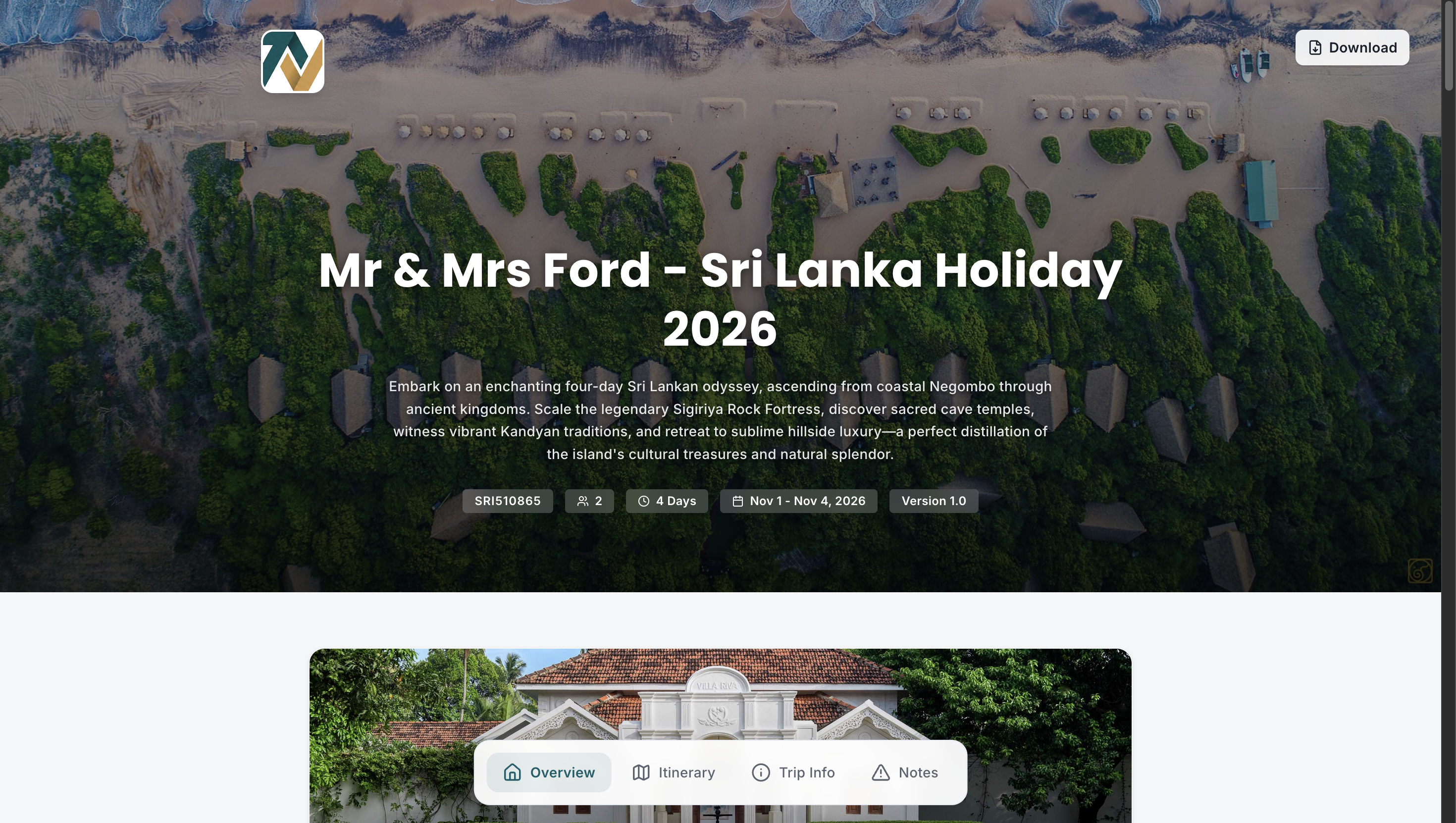
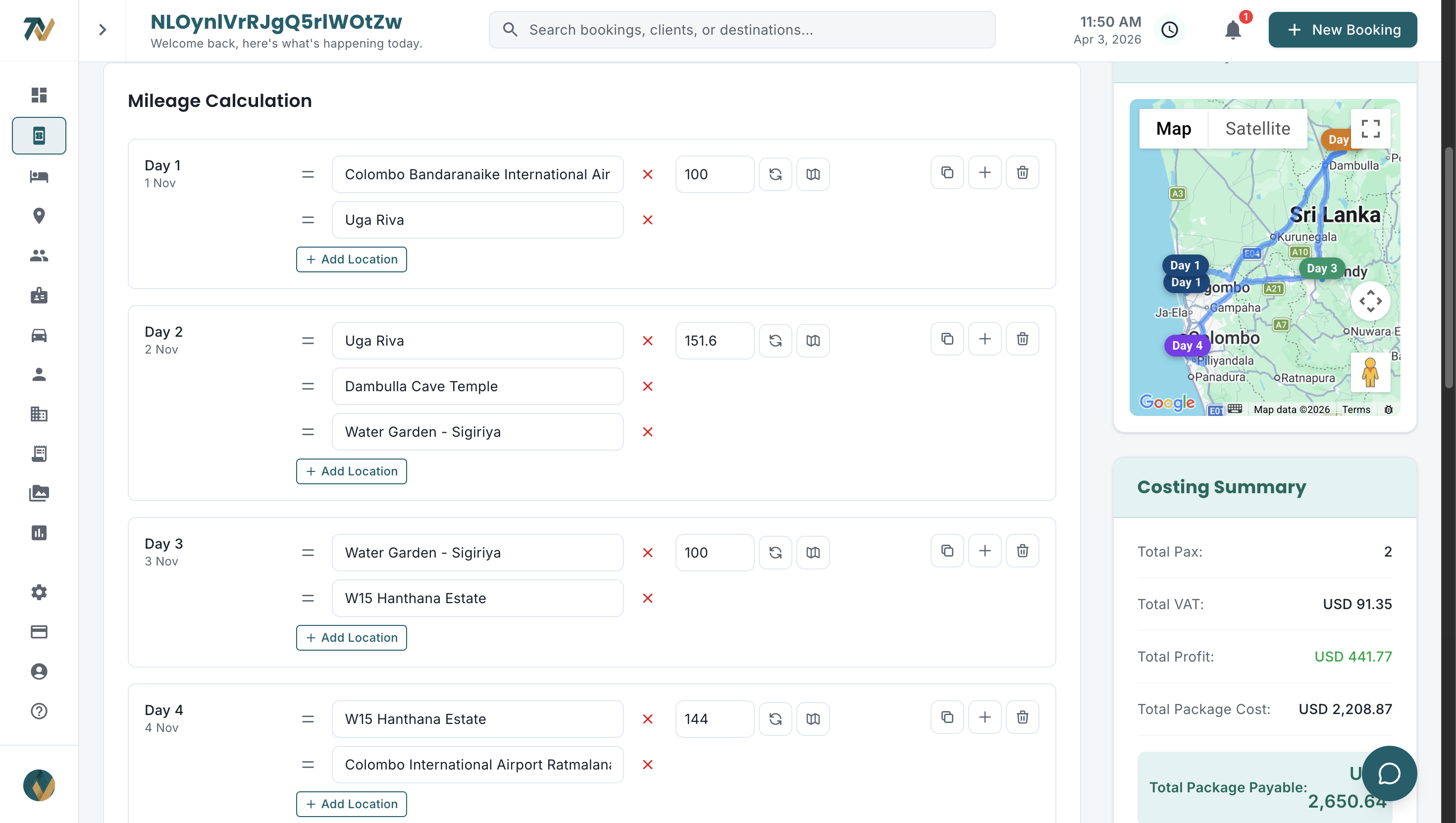
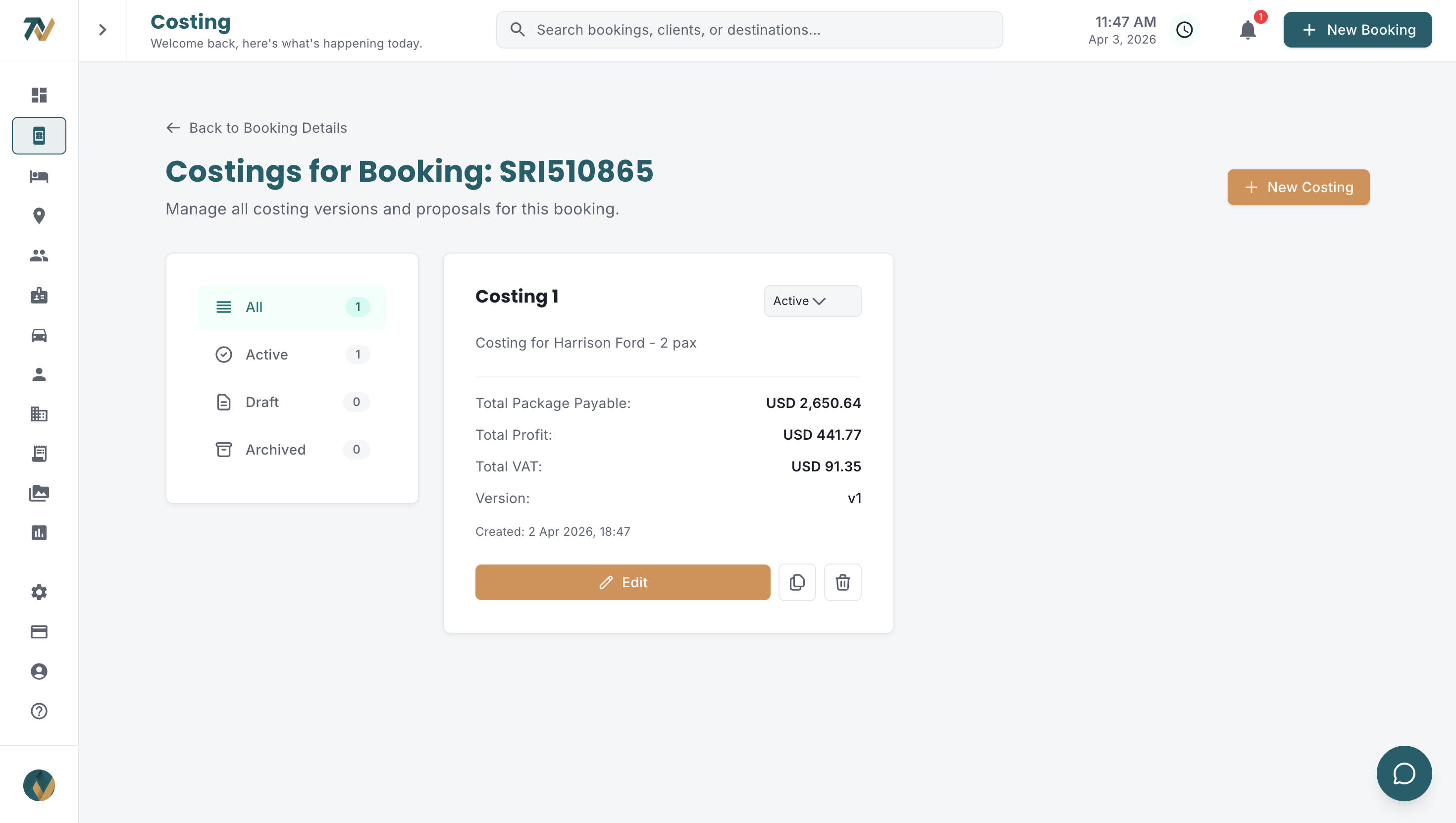
- One guided costing covers transport (automatic distance and mileage by vehicle type, with configurable per-km rates for eight standard types from Car and SUV to Mini Coach and 45 Seater, plus any custom vehicle types you add), hotels (room types, meal plans, seasonal rates), guides, activities and other expenses, then applies markup % and VAT and converts LKR costs to a USD selling price at a per-costing rate.
- Saved hotel rates are picked straight from the Rate Document Library, with seasonal rates by date range, occupancy prices and meal plans already extracted from your contracts, so nobody hunts through PDFs.
- One-click duplication clones a previous costing for a new inquiry, and Draft, Active and Archived versions keep several quotations per booking in order, with only one Active at a time.
- Documents come from the same data: a branded day-by-day itinerary with a shareable link, hotel vouchers generated from the costing's accommodation entries with one Generate Vouchers click (one per hotel), supplier vouchers, a client-facing confirmation voucher built from the active costing and itinerary, and invoices, with no Word formatting.
- Everything is sent from your own connected Gmail or Outlook with the send history recorded, so no one downloads a PDF and composes a separate email.
Removing the typing between enquiry and quote
Most of the delay between an agent's email arriving and a quote going back is transcription, not thinking. Someone reads the enquiry, works out what the agent wants and re-keys it into a booking form; then someone turns that booking into a costing, line by line.
Travify shortens both steps. On the New Booking form you paste the agent's email or upload the attached PDF or image, and AI extracts a structured draft (travellers, dates, tour, rooms, flights and special requests) with the filled fields highlighted for review. In the costing editor, AI auto-fill builds the costing from a typed or dictated description, or in one click from the booking, and can draft a sample itinerary from your company's past costings.
AI auto-fill drafts the costing for you to review, line by line, and fills inputs only: it never sets your markup %, VAT % or the LKR to USD rate, the per-km rate always comes from your company's vehicle rates rather than the AI, and all the pricing math runs through Travify's normal calculations, exactly as on a hand-built costing, so speed never comes at the cost of a number you cannot defend to an agent.
Your operations team then spends its time designing itineraries and building agent relationships instead of wrestling with spreadsheets. Plans start at $24 per month for a two-user Solo team; compare them on the pricing page.
Ready to reply faster?
Start your free trial and see how Travify shortens the path from agent inquiry to sent quotation.
Start your free trialarrow_forwardFrequently asked questions
Ready to Streamline Your Operations?
Join Sri Lankan travel companies already saving hours every week with Travify.
Related Articles
Excel Is Killing Your Tour Costing: Why DMCs Need Software
Excel was never designed for tour costing. Sri Lankan DMCs lose margin to silent formula errors, waste hours hunting rates and risk bookings on version confusion. Here is what dedicated costing software does differently.
Tour Package Costing: Step-by-Step Guide for Sri Lankan DMCs
Every cost component of a Sri Lankan tour package, worked on a 7-night, 2-pax circuit: hotels, mileage, activities, guides, supplements, markup, VAT and currency conversion, with the formulas in the right order.
B2B Travel Agent Management for Sri Lankan DMCs
India sent about 531,000 visitors to Sri Lanka in 2025 and the UK grew 24.9%. Behind those arrivals are travel agents. Here is how a DMC tracks, pays and keeps them.