
Peak Season Booking Management: A Guide for Sri Lankan DMCs
Sri Lanka’s December to March peak can double or triple a DMC’s live bookings with the same team. Here is how to run a status workflow, quote faster and keep vouchers moving without burning out.
Travify Team
Travel Operations Experts · April 13, 2026 · Updated October 6, 2026
In short: Sri Lanka’s December to March peak can double or triple a DMC’s live bookings with the same team. The operators who cope do five things before December: run every booking through a visible status workflow, duplicate costings instead of rebuilding them, send hotel vouchers the day payment lands, let AI handle lookups and data entry, and assign clear roles with a daily metrics review.
January 2026 was the busiest month Sri Lankan tourism has recorded, with the Sri Lanka Tourism Development Authority reporting 277,000 arrivals. For a destination management company (DMC), the local inbound tour operator that builds and runs tours for overseas travel agents, that surge is a stress test that exposes every gap in its operations.
The pattern repeats every year: inquiries trickle in through October, flood in by November, and from December to March the team works weekends while errors, missed vouchers and margin leaks multiply. This guide sets out what breaks and the systems that prevent it.
Key takeaways
- December to March brings a large share of Sri Lanka’s annual arrivals, so a DMC’s live bookings can double or triple with no change in headcount.
- A five-status booking workflow (Inquiry, Confirmed, Paid, In Progress, Completed) with one defined trigger per transition lets a manager see what needs attention in minutes.
- Duplicating an existing costing and adjusting dates, travelers and requests is far quicker than building every similar inquiry from scratch.
- Hotel vouchers should go out the day a booking turns Paid; in peak season a late voucher can cost the room.
- AI that reads an agent’s email into a booking draft, or answers “which hotel is this family at on 15 January?”, removes typing and clicking from the critical path.
- October and November are for preparation (roles, loaded rates, test vouchers, a daily metrics review) so that December is only execution.
How big is Sri Lanka’s December to March peak season?
December to March is Sri Lanka’s busiest period, driven by dry weather on the west and south coasts and in the Cultural Triangle, European winter holidays and long-haul travel patterns. Those four months account for roughly 40% of annual arrivals. With the country tracking towards more than 2.3 million arrivals in 2026, close to a million visitors are compressed into a third of the year. The 2026 operator outlook covers the full-year picture.
| Month | 2025 arrivals | 2026 arrivals | Year-on-year change |
|---|---|---|---|
| December | 213,000 | 241,000 (est.) | +13% |
| January | 248,000 | 277,000 | +11.7% |
| February | 226,000 | 252,000 (est.) | +11.5% |
| March | 198,000 | 220,000 (est.) | +11.1% |
As an illustrative example, a mid-sized DMC handling 30 to 50 bookings a month in low season may carry 80 to 120 live bookings in January: two to three times the workload with the same team.
Why do DMC operations break down between December and March?
Peak season breaks DMC operations because volume exposes every manual step: triage, costing, vouchers, communication and cost tracking all depend on people suddenly doing three times the work. Five failure modes cause most of the damage:
- Inquiry overload: travel agents and direct clients send dozens of requests a day. Without triage, a high-value group inquiry waits as long as a casual price check, and some are never answered. Slow agent replies lose bookings fastest in these weeks.
- Costing bottlenecks: every inquiry needs a costing, the build-up of hotel, transport, guide and activity costs in LKR that sets the USD quote. If one person owns costing, the whole pipeline waits on them.
- Voucher delays: as confirmed bookings pile up, hotel vouchers, transport documents and activity confirmations fall behind. Hotels release rooms, guests worry and your reputation takes the hit.
- Communication chaos: WhatsApp threads, email chains and phone calls scatter one booking’s information across five channels, so the team searches for the latest update instead of acting on it.
- Financial blindness: you quote a margin, actual costs come in differently, and without live visibility you only find the damage after the season ends.
Which booking status workflow keeps a DMC on track in peak season?
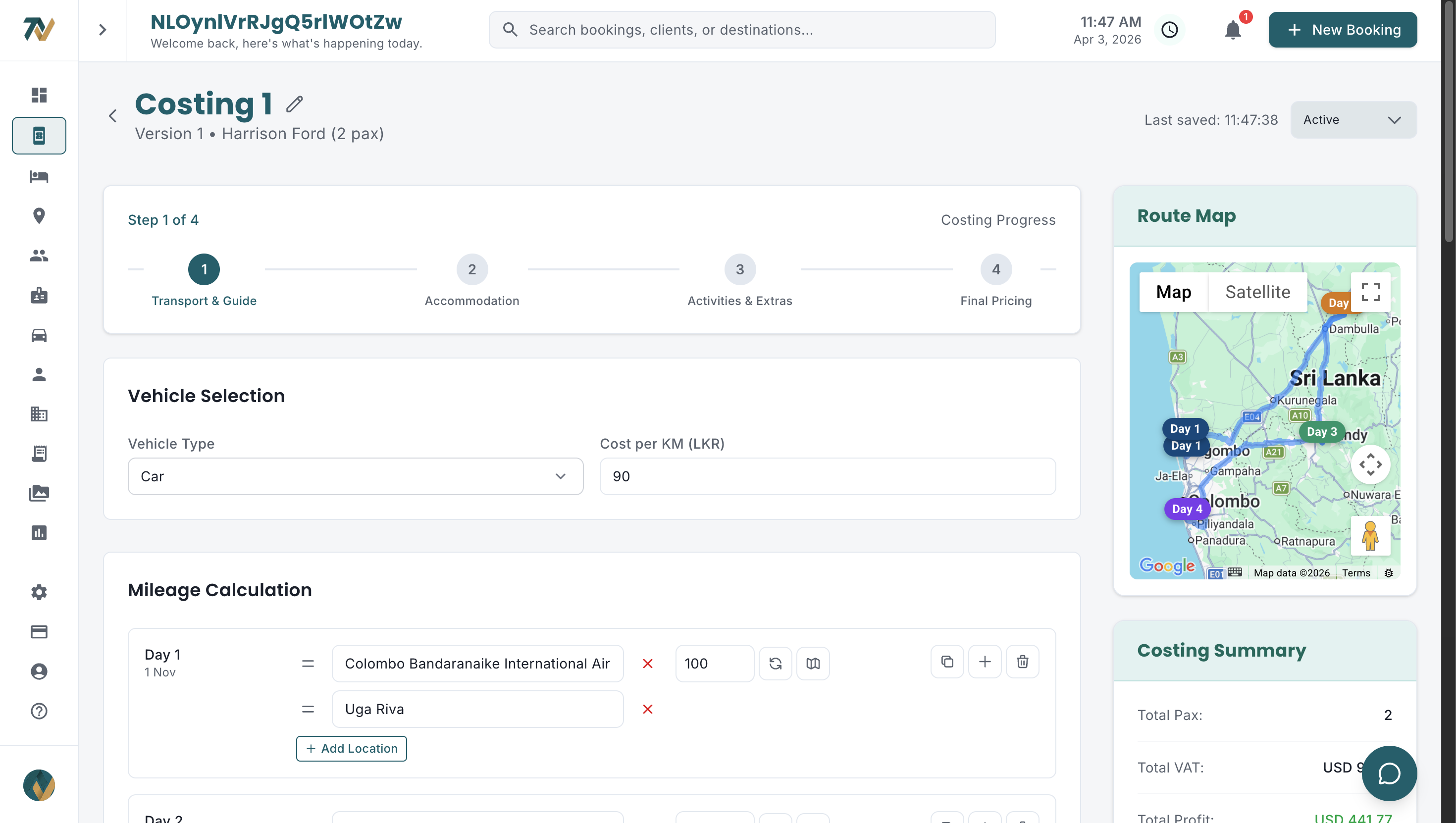
A five-status workflow (Inquiry, Confirmed, Paid, In Progress, Completed) with one defined trigger per transition is the single most effective change a DMC can make before December. Every booking gets a visible status the whole team can read at a glance, replacing spreadsheets, mental notes and starred WhatsApp messages.
Each transition has one trigger: the client accepting the quote moves Inquiry to Confirmed, a deposit receipt moves Confirmed to Paid, and the arrival date moves Paid to In Progress. Cancelled bookings leave the flow.
| Booking status | Trigger | Key actions at this stage |
|---|---|---|
| Inquiry | New request received | Build itinerary, create costing, send quote |
| Confirmed | Client accepts quote | Request hotel allotments, send to Transport to assign guide and vehicle |
| Paid | Deposit or full payment received | Send hotel vouchers, confirm suppliers, issue transport documents |
| In Progress | Arrival date reached | Monitor the live tour, handle changes, track expenses |
| Completed | Tour ends | Collect feedback, reconcile costs, settle suppliers |
Start each day with the bookings in Confirmed (need vouchers and transport assignments) and In Progress (need live monitoring). A ten-minute review catches problems before they escalate.
Which metrics should the dashboard show from December onwards?
Track five numbers daily in peak season: active bookings by status, revenue this month against last, average response time to new inquiries, the voucher backlog (confirmed bookings without vouchers) and supplier confirmation rate. Weekly, add revenue by travel agent and margin by market. If any moves the wrong way, you catch it in time to correct course.
How do you quote faster when peak-season inquiries look alike?
Duplicate an existing costing and adapt it; do not build each similar inquiry from zero. Peak-season requests cluster: a UK agent sends five couples wanting a seven-day Cultural Triangle tour in January, and a German wholesaler needs ten variations of a ten-day wildlife-and-beach combination. Each is mostly identical to the last.
Keep a reference costing for each of your most common routes. The hotels, vehicle type, guide days and activities are already in place, so a new inquiry means adjusting dates, traveler numbers and special requests, then checking the seasonal rates. Per quote the saving is modest; across a December of similar inquiries it is substantial.
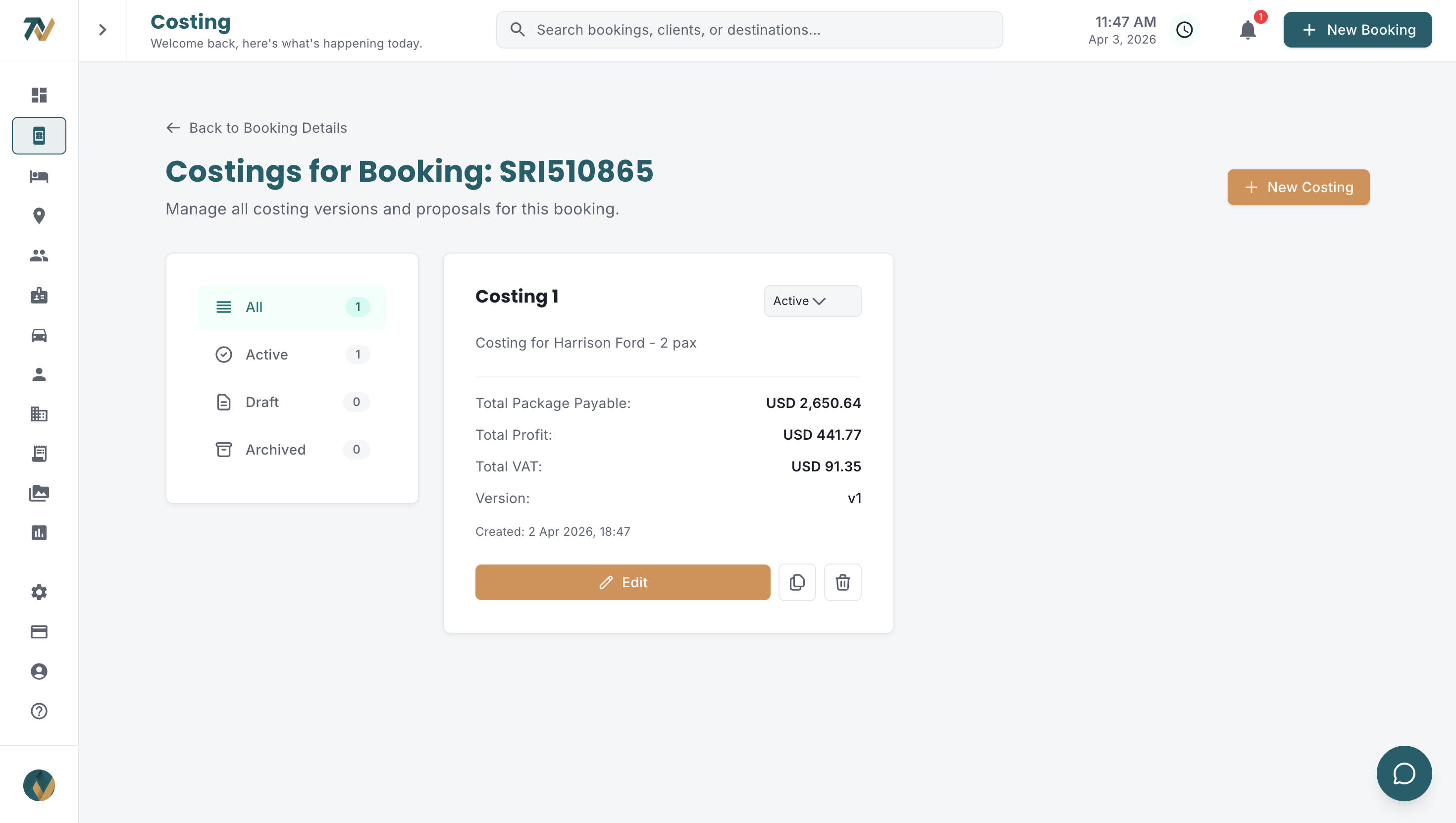
Travify duplicates a costing in one click, so a designer starts from a proven cost build and adjusts dates, pax and requests. Seasonal hotel rates are picked straight from the Rate Document Library inside the costing instead of being retyped.
How do you keep hotel vouchers from falling behind in December?
Generate hotel vouchers from the booking file and send them the same day payment lands. A hotel voucher is the document that confirms a guest’s stay to the property, and hotels use it to hold the allotment. In peak season, when properties in Sigiriya, Ella and along the south coast run close to full, a late voucher can mean a lost room.
Manual voucher creation, copying names, dates, room types and meal plans into a Word template, is error-prone at the best of times. When the team pushes out a stack of vouchers every day, the error rate climbs: a misspelled name or wrong check-in date leaves a guest at a front desk with a voucher that does not match the reservation.
The fix is to assemble the voucher from data already in the booking: guest names, dates, rooms, meal plans and special requests are entered once and reused in every document. Our guide to hotel voucher management walks through the full workflow, including confirmation tracking.
Do not batch voucher generation for later. The moment a booking moves to Paid, generate and send every hotel voucher. This locks in allotments and removes a task from your future self during the busiest weeks.
How can AI save a DMC team time during the peak-season rush?
AI helps most at the two points where peak season consumes the most typing and clicking: routine lookups and transcribing inquiries into bookings and costings. Neither touches pricing; both shorten the path between an inquiry landing and a quote going out.
Instant answers to “where is this booking?”
In peak season the phone never stops: an agent wants a booking status, a driver a pickup time, a hotel an arrival date. Each answer is simple, but finding it means opening the right booking and section, and dozens of lookups a day become lost hours. An in-app assistant that reads your own bookings answers directly: ask “Which hotel is the Peterson family at on 15 January?” and get the answer without clicking through menus.
Bookings and costings drafted from an agent’s email
Inquiry volume peaks exactly when designers have the least time. Pasting an agent’s email, or uploading their PDF, into a new booking returns a structured draft (travelers, dates, rooms, flights, special requests) highlighted for review, removing the transcription step when it hurts most. In the costing, describe or dictate the holiday, or build it in one click from the booking, then review the draft.
How should a Sri Lankan DMC prepare in October and November?
Prepare while inquiry volume is still manageable. October and November are for assigning roles, loading rates, testing documents and setting up reporting, so that from 1 December the team only executes.
Assign clear roles before the rush
In a small DMC everyone does everything: the owner builds costings, the operations manager sends vouchers, the trainee handles WhatsApp. That works in low season and collapses in peak season because nothing has a clear owner. Decide who owns inquiry response, costing, vouchers and supplier confirmations, and live-tour monitoring; they need not be different people, but each task must be assigned.
| Role | Responsibilities | Peak-season priority |
|---|---|---|
| Owner / Director | Strategic decisions, pricing approval, agent relationships | Focus on high-value bookings and partner management |
| Operations Manager | Booking workflow, voucher approval, supplier coordination | Ensure every confirmed booking has complete vouchers |
| Staff / Coordinator | Data entry, itinerary building, document generation | Process inquiries fast, duplicate reference costings, cut turnaround time |
A common peak-season mistake: the owner gets pulled into operations and stops answering agents, so operations still struggle and new business dries up too. Delegate before the rush so the sales pipeline stays open.
The pre-season checklist
- Audit the booking workflow: is every status defined, and does the team know the trigger for each transition?
- Build reference costings: keep five to ten for your most popular routes (Cultural Triangle, hill country, south coast, Yala and Wilpattu wildlife, and combinations) ready to duplicate.
- Load pre-negotiated rates: lock in hotel and transport rates for the season and enter them so costings pick seasonal prices instantly. Our guide to hotel rate management covers keeping contracts current.
- Test voucher generation: produce a test voucher for every hotel you use regularly and check the format, content and reservations email address.
- Set system permissions to match roles: in Travify that means giving each person a department (Travels, Transport, Procurement or Finance) and a job title, and assigning Travels members the sales markets they cover: Market and Assistant Managers see every booking in their market, while Travel Designers see only the bookings they created or are assigned to.
- Set up reporting: in Travify, Reports cover bookings, agent performance and margin by market, agent and designer, Procurement’s Supplier Performance page shows each hotel’s confirmation rate and average days to confirm, and unsent-voucher reminders flag bookings whose vouchers have not gone out before the tour starts. Decide how you will track inquiry response time, then review the numbers daily from 1 December.
- Brief your agents: tell international partners your peak-season process, expected response times and any booking cut-off dates.
How Travify helps a Sri Lankan DMC through peak season
Travify helps by making the existing team faster rather than larger. Hiring for four months is expensive and slow; by the time a new hire is productive, the season is half over. Making the current team faster is the pattern behind scaling a tour operation without proportional hiring.
- One booking file per inquiry carries travelers, dates, rooms, flights, payments and special requests through Inquiry, Confirmed, Paid, In Progress and Completed, with an append-only Change Log, so nobody hunts across WhatsApp for the latest version.
- Paste an agent’s email or upload a PDF on the New Booking form and AI returns a structured draft, highlighted for review, in place of manual transcription.
- Costings are duplicated in one click, filled by AI from a description or from the booking, and pick seasonal hotel rates from the Rate Document Library.
- Hotel vouchers, transport documents and invoices are generated from the booking and emailed from your own Gmail or Outlook, with send history recorded. Sent hotel vouchers carry a Confirmed tick, and a sent voucher that stays unconfirmed for three or more days triggers a daily reminder until someone ticks it, which matters most with eighty bookings live at once.
- Confirmed bookings reach the Transport department as requests, where guides and vehicles are assigned against free and busy dates with overlaps blocked.
- Procurement’s Rate Coverage grid turns red when a live costing needs a month with no hotel rates, which is exactly the gap that otherwise surfaces in a January scramble.
- Jarvis, the in-app assistant, answers questions about your own bookings and operations, and Reports show margin by market, agent and designer while the season is still running.
- Each member belongs to a department with a job title that sets access, so menus and pages show what each person needs and nothing else. See how the departments fit together and plan pricing; every plan starts with a free trial.
Ready to handle next peak season with confidence?
Travify gives your team the workflow, automation and visibility to handle peak-season volume without peak-season chaos. Start your free trial before the rush.
Start your free trialarrow_forwardFrequently asked questions
Ready to Streamline Your Operations?
Join Sri Lankan travel companies already saving hours every week with Travify.
Related Articles
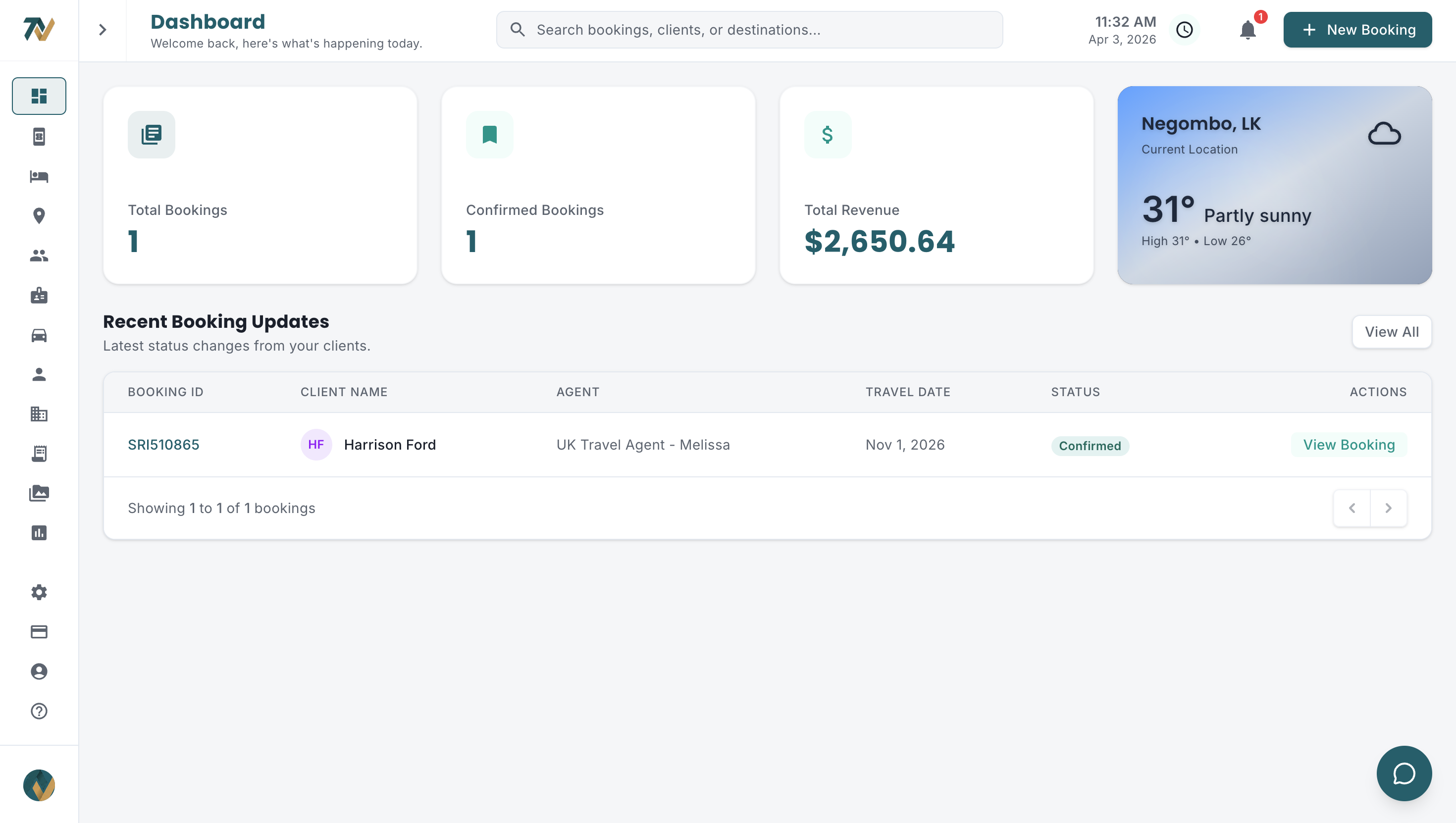
Sri Lanka Tourism 2026: What Tour Operators Should Know
Sri Lanka recorded 2.36 million arrivals in 2025 and January 2026 set a monthly record. Behind the headline, source markets and seasonality are shifting in ways every Sri Lankan DMC needs to plan for.
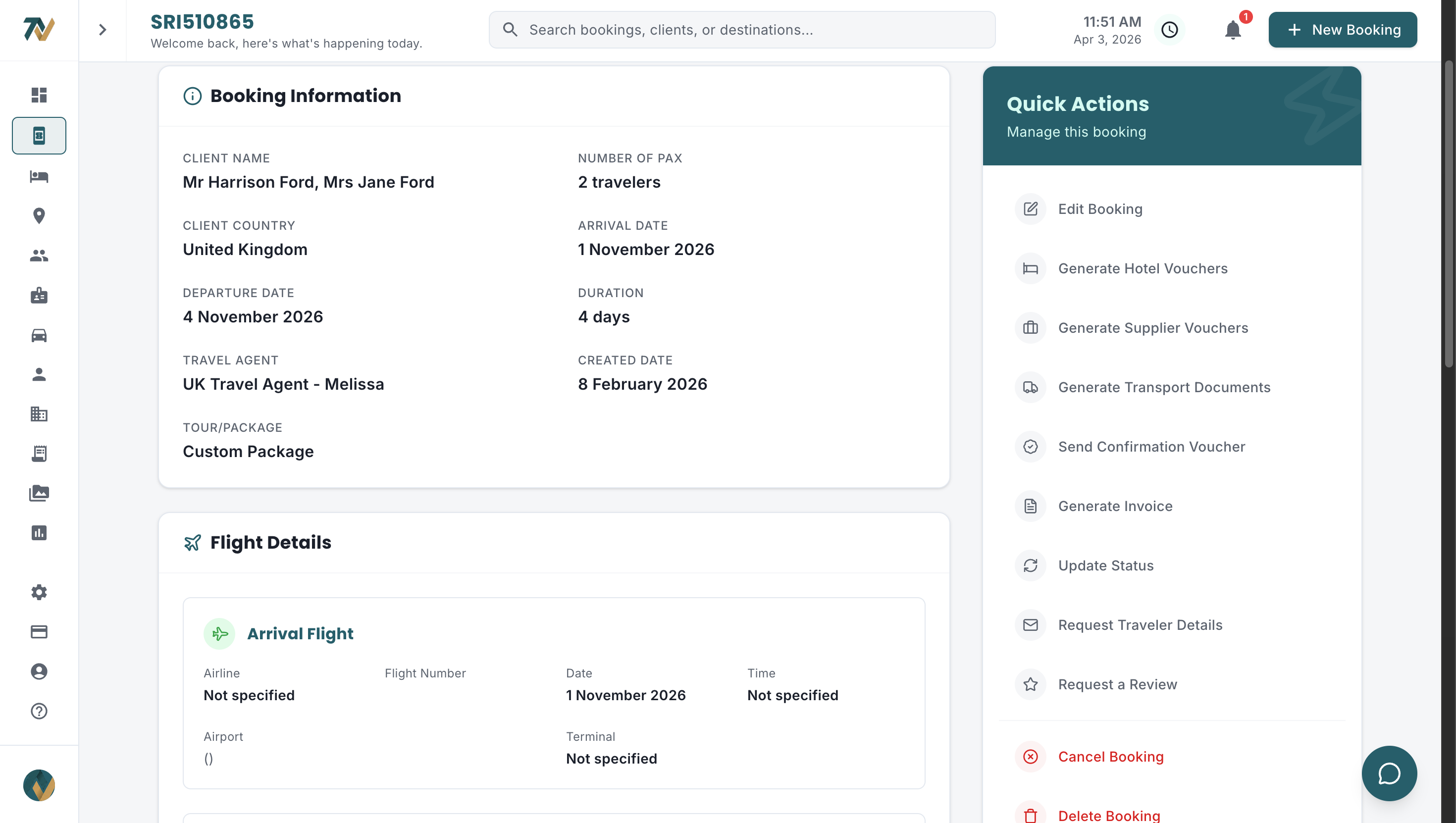
Hotel Voucher Management for DMCs: From Chaos to One Click
Hotel vouchers are the workhorses of tour operations. When they are wrong, late or missing, the cost ranges from embarrassing to expensive. Here is how Sri Lankan DMCs fix the voucher process.
How to Scale a Tour Operation from 10 to 100 Bookings a Month
Manual processes that work at 10 bookings a month break at 20, 40 and 80. Here is where Sri Lankan DMCs hit the wall, the six systems that get them past it, and a realistic rollout order.