
Sri Lanka Tourism 2026: What Tour Operators Should Know
Sri Lanka recorded 2.36 million arrivals in 2025 and January 2026 set a monthly record. Behind the headline, source markets and seasonality are shifting in ways every Sri Lankan DMC needs to plan for.
Travify Team
Travel Operations Experts · April 13, 2026 · Updated October 6, 2026
In short: Sri Lanka recorded 2.36 million tourist arrivals in 2025 and is targeting 3 million in 2026. India is the largest source market, the UK is the fastest-growing major market, Russia is declining and China is still recovering. For a Sri Lankan DMC, the response is to diversify source markets, add premium and wellness products, and run costing, vouchers and finance on systems that absorb more bookings without more staff.
Sri Lanka's tourism industry has recovered from the 2019 Easter attacks, the COVID-19 pandemic and the 2022 economic crisis faster than most forecasts expected. For a Sri Lankan DMC (destination management company: the local inbound tour operator that designs, prices and delivers ground arrangements for overseas travel agents), the headline numbers bring more inquiries, more competition and more operational pressure.
Key takeaways
- Sri Lanka received 2.36 million tourist arrivals in 2025, up 15.1%, and the government target for 2026 is 3 million, a 27% increase.
- India (531,000 arrivals, the largest share by a wide margin) is the volume market; the UK (212,000, up 24.9%) overtook Russia as the second-largest market and brings longer, higher-value trips.
- Russia fell 13.4% and China is still recovering, so a DMC that depends on a single source market should diversify now.
- Government policy is pivoting from volume to high-value tourism: wellness and Ayurveda, eco-tourism, premium cultural experiences and adventure travel.
- A 27% rise in arrivals means roughly 27% more inquiries, vouchers and reconciliations; process efficiency, not headcount, decides which operators keep their margins.
How many tourists visited Sri Lanka in 2025, and what is the 2026 target?
Sri Lanka recorded 2.36 million tourist arrivals in 2025, a 15.1% increase on 2024, with tourism revenue above $3.2 billion. The official target for 2026 is 3 million arrivals, a 27% increase. January 2026 opened with 277,327 arrivals, an all-time monthly record and 9.7% higher than January 2025.
| Market or metric | 2025 result | Change vs 2024 | What it means for operators |
|---|---|---|---|
| Total arrivals | 2.36 million | +15.1% | Strongest post-crisis year, approaching pre-2019 levels |
| Tourism revenue | $3.2 billion+ | Significant increase | Higher spending per visitor |
| January 2026 arrivals | 277,327 | +9.7% YoY | All-time monthly record, strong start to the year |
| India (top market) | 531,000 arrivals | +20% YoY | Largest market share, dominant and growing |
| United Kingdom | 212,000 arrivals | +24.9% YoY | Overtook Russia as the second-largest market |
| Russia | 187,000 arrivals | -13.4% YoY | Declining on geopolitical and currency pressures |
| Germany | 148,000 arrivals | Stable growth | Consistent European market with high per-trip spend |
| China | 132,000 arrivals | Recovering | Gradual return toward pre-COVID levels |
| Australia | 109,000 arrivals | Growing | High-value market with longer stays |
| France | 109,000 arrivals | Growing | Steady European market with cultural tourism interest |
Reaching 3 million requires 27% growth in a single year, which is aggressive even for a recovering destination, but January 2026 grew 9.7% on an already strong base. The monthly releases from the Sri Lanka Tourism Development Authority through the first quarter are the clearest early indicator of whether the target is on track.
Why is India the biggest source market for Sri Lankan DMCs?
India sent 531,000 visitors to Sri Lanka in 2025, 20% more than the year before, which makes it the largest source market by a wide margin. Short flights from major Indian cities and strong cultural ties keep that volume growing. Six characteristics of the market shape how an inbound tour operator must work:
- Shorter booking lead times: Indian travelers frequently book weeks rather than months ahead, so inquiry-to-confirmation must be fast.
- Family and small-group travel: bookings are weighted toward families and small groups, which need flexible vehicle and room configurations.
- Value-conscious with quality expectations: budget-aware does not mean basic; the expectation is the best possible experience at a competitive price.
- Vegetarian meal requirements: a large share of Indian travelers need vegetarian meals, so meal plans must be tracked in every hotel and restaurant booking.
- Religious and cultural tourism: the Temple of the Tooth in Kandy, Anuradhapura, and the Ramayana trail sites around Nuwara Eliya feature alongside the standard cultural and wildlife circuits.
- Holiday-driven peaks: arrivals spike around Diwali, Pongal, Indian school holidays and long weekends, so the Indian holiday calendar belongs in your demand forecasting.
Keep three to five ready-to-duplicate costings designed for the Indian market: a 4-night Colombo, Kandy and Nuwara Eliya quick circuit, a 6-night family tour, a 5-night honeymoon package and a religious tourism circuit. Having these ready saves hours in the high-volume booking windows around Diwali, Pongal and school holidays.
What is changing in the UK, European, Russian and Chinese markets?
The United Kingdom is now Sri Lanka's second-largest source market, with 212,000 arrivals in 2025 and 24.9% growth, overtaking Russia, which fell 13.4% to 187,000. Germany (148,000), France (109,000) and Australia (109,000) remain steady, and China (132,000) is recovering rather than at full strength.
British travelers tend to book longer itineraries, often around two weeks versus roughly a week for Indian travelers, prefer higher-category hotels in Galle, Ella and the Cultural Triangle, and pay premium rates for unique experiences. Revenue per booking from a UK client is typically far higher than from a short Indian family trip, so the market matters more than its volume suggests.
Germany shares the UK profile: longer stays, higher spend and strong interest in cultural and nature-based tourism. France and Australia round out the major markets, from French interest in heritage sites to Australian surf and extended-stay travel.
The decline of the Russian market (-13.4%) looks structural, not a temporary dip. A DMC that relied heavily on Russian volume should diversify now toward growing markets such as the UK and India and recovering markets such as China.
Is the Chinese market returning to Sri Lanka?
Yes, gradually. China's 132,000 arrivals in 2025 represent a market in recovery rather than at full strength. Before COVID, China was one of Sri Lanka's fastest-growing source markets, and China's outbound tourism market is the largest in the world, which gives Sri Lanka large long-term upside as a warm-weather destination with cultural appeal.
For a DMC, the Chinese recovery is a medium-term opportunity worth investing in now: Mandarin-speaking guides, WeChat communication, familiar payment options and itineraries that suit Chinese preferences give a first-mover advantage as the market returns to full volume.
What is Sri Lanka's high-value tourism pivot, and how does it affect tour operators?
Sri Lanka's tourism policy is shifting from arrival volume to spend per visitor: the aim is higher-spending tourists, not only more of them. The 2.36 million arrivals of 2025 generated $3.2 billion, and the same visitors could deliver far more if average spend per trip rises. The pivot shows up in five ways that affect DMC operations:
- Luxury and boutique accommodation: new high-end properties are opening across the island, creating inventory for premium itineraries that did not exist two years ago.
- Wellness and Ayurveda tourism: Ayurveda retreats, yoga centres and wellness resorts are seeing strong growth from high-spending travelers on multi-week stays.
- Eco-tourism and sustainable travel: nature-based experiences with sustainability credentials command premium pricing, supported by national parks such as Yala, Wilpattu and Minneriya and an emerging eco-lodge network.
- Elevated cultural and heritage tourism: village stays, traditional craft workshops and tea estate experiences in the hill country are being developed as premium products beyond the standard circuit.
- Adventure tourism: surfing at Arugam Bay and Weligama, diving, trekking and cycling holidays attract younger, higher-spending travelers who stay longer and book more activities.
The product mix must evolve accordingly. Operators who design and deliver premium experiences, such as wellness retreats, luxury wildlife safaris and immersive cultural journeys, capture more revenue per booking; those who sell only the standard cultural circuit at budget prices face rising competition and shrinking margins.
What does 3 million arrivals mean for DMC operations?
A 27% rise in arrivals means roughly 27% more inquiries, quotations, hotel confirmations, vouchers and reconciliations. The question for every inbound tour operator is whether current processes can absorb that volume without a matching increase in staff.
| Operational area | Impact of a 27% volume increase | Preparation required |
|---|---|---|
| Inquiry handling | 27% more inquiries requiring quotations | Faster costing tools, template costings, AI capture of inquiry details |
| Hotel coordination | More bookings competing for popular property allocations | Earlier booking, stronger hotel relationships, current contracted rates |
| Transport logistics | More vehicles needed in peak periods, driver availability pressure | Advance vehicle allocation, diversified transport supplier network |
| Guide availability | Higher demand for quality English-speaking guides | Early guide booking, relationship building, new guide onboarding |
| Financial management | 27% more invoices, payments and reconciliations | Automated invoicing, settlement tracking, financial reporting |
| Communication volume | More emails, WhatsApp messages and follow-ups | Email-to-booking capture, one booking file per inquiry, send history |
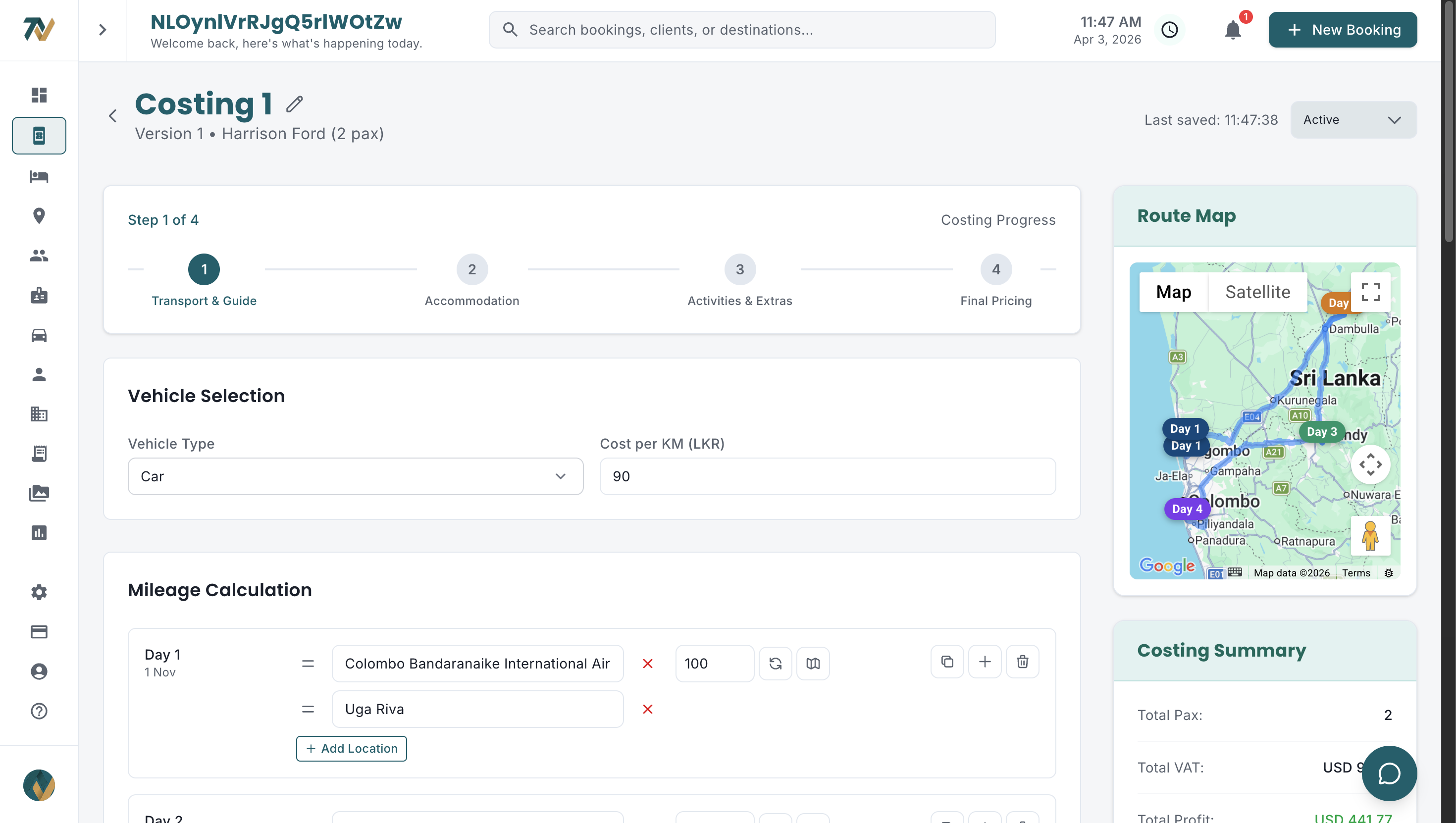
The operators who struggle most in growth periods are those whose manual processes only worked at lower volumes. As an illustrative example, if one costing takes two hours to build and inquiries rise by a quarter, you either hire proportionally more staff or cut the time per costing. Most Sri Lankan DMCs cannot hire fast enough, so process efficiency becomes the bottleneck.
Which tourism trends should Sri Lankan tour operators watch in 2026?
Four trends will shape demand and partner expectations in 2026: the wellness and Ayurveda boom, digital-first booking behaviour, agent consolidation and sustainability as a booking decision factor.
Trend 1: the wellness and Ayurveda boom
Wellness is becoming a mainstream travel motivation rather than a niche, and Sri Lanka's authentic Ayurveda tradition is a genuine advantage over destinations that treat wellness as an add-on. A DMC that packages one- to two-week itineraries combining Ayurveda treatments with cultural experiences reaches one of the fastest-growing, highest-spending segments in global tourism.
Trend 2: digital-first booking behaviour
Travelers and agents increasingly expect digital interactions: online itineraries, fast quotations, digital vouchers and professional documents. A DMC still sending hand-formatted Word documents and asking agents to call for prices creates friction that pushes business to more digitally capable competitors.
Trend 3: agent consolidation and rising quality expectations
International B2B travel agents (overseas agencies that resell your tours to their own clients) are consolidating their DMC partnerships, working deeply with fewer reliable partners instead of long supplier lists. The bar for staying a preferred partner is rising: consistent quality, fast replies, professional documentation and transparent data, which takes operational systems, as our guide to managing international B2B agents explains.
Trend 4: sustainable tourism as a market differentiator
Sustainability is shifting from a marketing phrase to a booking decision factor. European travelers ask about carbon footprint, waste management at hotels, community impact and wildlife protection policies. A DMC that can state and demonstrate its sustainability practices holds a tangible advantage in the UK, German and French markets.
How should a Sri Lankan DMC prepare for 2026?
Start with rates, template costings and operational tools, then lock in hotel, guide and vehicle supply for the December to March peak season before August. These eight steps follow from the market dynamics above:
- Audit and update your hotel rate database. Make sure every contracted rate is current for the 2026 seasons; hotels are raising rates as demand grows, and outdated rates erode margins (see our guide to hotel rate management).
- Build market-specific template costings. Keep ready-to-duplicate costings for Indian travelers (short, family-focused stays), UK travelers (longer circuits) and wellness seekers (one- to two-week retreat packages).
- Invest in operational tools. If your team still builds costings in Excel, adopt purpose-built DMC software before the volume increase breaks processes that barely cope today. Our article on scaling a tour operation covers what to look for.
- Strengthen your guide and transport network. Peak demand creates availability pressure, so lock in relationships and allocations early, especially for the December to March peak season.
- Develop wellness and premium products. Even if your core business is mid-range cultural circuits, two or three premium and wellness itineraries in the portfolio position you for the high-value segment.
- Track agent performance. Know which travel agents send the most and highest-value bookings and the best conversion, and invest your time and marketing budget there.
- Implement settlement tracking. A settlement is the post-tour reconciliation of revenue against actual costs and payments; as volume grows, track planned versus actual cost on every booking, as our guide to settlement and profit tracking shows.
- Prepare for the Chinese market return. Building language support, payment options and market-appropriate itineraries while volumes are modest positions you for the long-term growth.
The December to March peak season fills earlier every year. Begin negotiating hotel allocations and guide availability by May or June 2026; by August, the best rooms at popular properties in Galle, Yala, Kandy and the Cultural Triangle on peak dates are usually committed. Planning ahead means better rates, better availability and less stress in the busiest months.
Growth does not benefit every operator equally. The DMCs that capture a disproportionate share of it have efficient operations, diversified markets, premium products and technology that scales with volume; those that run on manual processes, depend on one source market and compete only on price will find 2026 harder, not easier.
How Travify helps tour operators handle 2026 growth
Travify is web-based travel operations software for Sri Lankan DMCs and inbound tour operators, built so a team can absorb more bookings without proportionally more staff. It addresses each pressure point above:
- Faster inquiry turnaround: paste an agent's email or upload a PDF on the New Booking form and AI extracts travelers, dates, rooms, flights and requests into a draft booking for review, so a short-lead inquiry is in the system in minutes.
- Template costings without a spreadsheet: a guided costing covers transport with automatic mileage by vehicle type, hotels with seasonal rates and meal plans, guides, activities, markup and VAT; duplicate a costing in one click or let AI auto-fill it from the booking.
- Current hotel rates: upload contracts, rate sheets and offers to the Hotel Rate Document Library, where AI extracts seasonal rates by date range, meal plans and cancellation terms; the Procurement Rate Coverage grid flags any month a live costing needs but has no rates for.
- Guide and vehicle allocation under peak pressure: confirmed bookings reach the Transport department as requests, and assigning a guide and vehicle shows free or busy per date, blocks overlaps and warns on seat counts.
- Vouchers and invoices at volume: hotel vouchers carry a confirmation tick, unconfirmed-voucher reminders and cancellation deadlines; invoices track line items, VAT, payments and balance due; everything is emailed from your own Gmail or Outlook with send history recorded.
- Finance that scales: a payable (an amount owed to a hotel, supplier or guide) is created automatically when a hotel voucher is confirmed, a supplier voucher is sent or a tour is closed; a settlement opens when a booking is marked Completed; and reports show monthly P&L by departure month and margin by market, agent and designer.
- Markets and agents: six built-in sales regions plus custom markets with per-market booking numbering, and travel agents grouped by company with performance stats showing which partners send the most and best bookings.
See the full Travify solutions overview for each department, or compare plans starting at $24 per month. Every plan starts with a free trial.
Prepare your DMC for 2026 growth
Travify gives Sri Lankan tour operators the operational tools to handle growing volumes: AI-assisted costing, contracted hotel rates read straight out of your rate documents, hotel vouchers with confirmation tracking, and date-filtered business analytics across bookings, hotels, agents, finances and customers.
Start your free trialarrow_forwardFrequently asked questions
Ready to Streamline Your Operations?
Join Sri Lankan travel companies already saving hours every week with Travify.
Related Articles
Peak Season Booking Management: A Guide for Sri Lankan DMCs
Sri Lanka’s December to March peak can double or triple a DMC’s live bookings with the same team. Here is how to run a status workflow, quote faster and keep vouchers moving without burning out.
How to Scale a Tour Operation from 10 to 100 Bookings a Month
Manual processes that work at 10 bookings a month break at 20, 40 and 80. Here is where Sri Lankan DMCs hit the wall, the six systems that get them past it, and a realistic rollout order.
B2B Travel Agent Management for Sri Lankan DMCs
India sent about 531,000 visitors to Sri Lanka in 2025 and the UK grew 24.9%. Behind those arrivals are travel agents. Here is how a DMC tracks, pays and keeps them.