
Tour Settlement and Profit Tracking for Sri Lankan DMCs
You quoted a healthy margin on a 10-day tour, but once the supplier invoices arrived the earned margin was lower. Per-booking settlement shows exactly which cost line took the difference.
Travify Team
Travel Operations Experts · April 13, 2026 · Updated October 6, 2026
In short: Settlement is the per-booking reconciliation of what you planned to spend (the costing) against what you actually paid suppliers and what the client actually paid you. Most Sri Lankan DMCs quote a margin but never measure the earned one, so overruns in transport, hotel rates and mid-tour extras go unnoticed. Settling every completed booking, category by category, shows exactly where profit leaks and feeds accurate numbers back into future quotes.
Ask a Sri Lankan DMC (destination management company) owner what their profit margin is and you will usually hear the margin they quote, not the margin they earn. The gap between the two is where inbound tour operator profit quietly disappears: a hotel invoice above the contracted rate, a route change that added kilometres, a lunch upgrade the guide arranged but nobody billed. Each is small on its own; across a December to March season they decide whether the year is profitable.
Key takeaways
- Settlement compares the costing (planned costs) with actual supplier invoices and client payments for one booking, and it should happen for every completed tour, not only problem ones.
- Transport, hotel rate differences and untracked mid-tour extras are the three places where cost variance most often hides on a Sri Lankan itinerary.
- Settlement has two halves: cost variance by category, and payment status for every supplier (a payable) and every client or agent invoice (a receivable).
- Settlement data pays off only when it feeds back into costing: transport buffers, supplier accountability and markup by itinerary type.
- A short weekly settlement review during peak season prevents the year-end discovery that earned margin sat several points below quoted margin.
- Travify creates a settlement automatically when a booking is marked Completed and tracks it as Open, In progress or Settled until it is closed.
What is tour settlement, and why do most DMCs skip it?
Tour settlement is the process of reconciling what a DMC planned to spend on a booking with what it actually spent and collected. In accounting terms it is variance analysis at the booking level; in practice it is the only moment you learn whether a tour was profitable.
Most inbound tour operators skip the step. The tour ends, the guests leave a good review, and the team moves on to the next arrival. Supplier invoices trickle in over the following weeks and someone pays them, but nobody asks whether the booking earned what the costing promised.
Operators who do ask, and have the data to answer, catch pricing errors before they repeat, spot suppliers who invoice above contract, and learn which itinerary types are profitable in practice rather than on paper. The real cost of tour costing errors only becomes visible once settlement exists.
What does per-booking settlement look like?
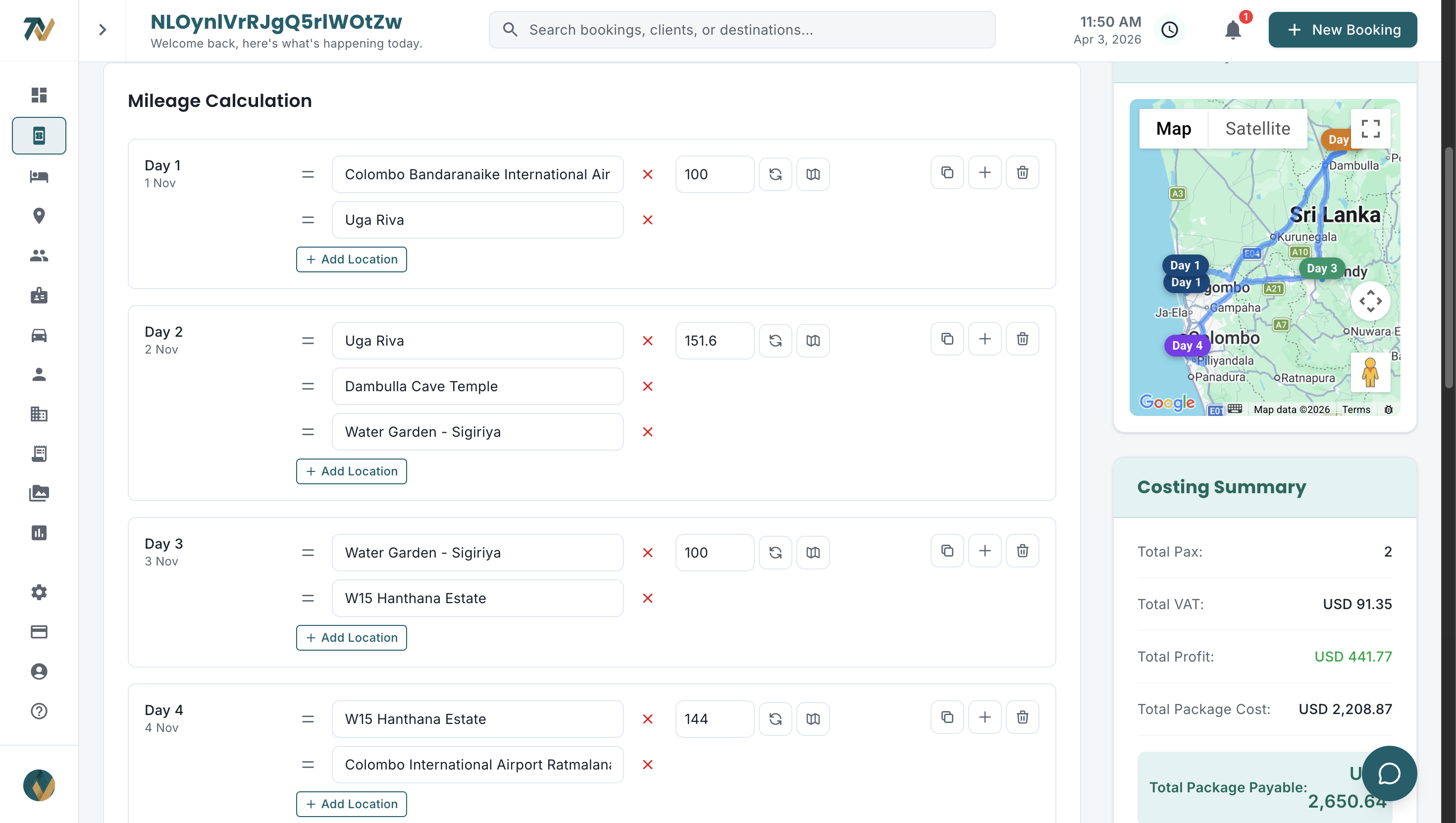
A per-booking settlement lists every cost category, shows the planned cost from the costing beside the actual cost from supplier invoices, and calculates the variance (the difference between the two) in amount and percentage. The costing is the baseline, so a complete, line-by-line tour costing is the prerequisite.
The table below is an illustrative example for a 10-day private tour, converted to USD so the client payment and the costs sit in one currency:
| Cost category | Planned (USD) | Actual (USD) | Variance | Variance % |
|---|---|---|---|---|
| Accommodation | $1,850 | $1,920 | +$70 | +3.8% |
| Transport | $480 | $535 | +$55 | +11.5% |
| Activities & excursions | $340 | $340 | $0 | 0% |
| Guide fees | $280 | $280 | $0 | 0% |
| Meals & dining | $190 | $225 | +$35 | +18.4% |
| Other expenses | $60 | $85 | +$25 | +41.7% |
| Total cost | $3,200 | $3,385 | +$185 | +5.8% |
| Client payment | $4,100 | $4,100 | $0 | 0% |
| Planned profit | $900 (22.0%) | — | — | — |
| Actual profit | — | $715 (17.4%) | -$185 | -4.5 pts |
In this illustrative example the operator quoted a 22% margin and earned 17.4%. Transport ran over because the guests asked for a detour on the Kandy to Ella leg, and meals ran over because they chose a more expensive restaurant twice. One booking's shortfall is manageable; repeated across a peak season it is a meaningful share of annual profit.
Why small gaps matter: a consistent five-point gap between planned and actual margin on 200 bookings a year at an average value of $3,500 is $35,000 of profit that exists in the costing but never reaches the bank. The figures are illustrative; the mechanism is not.
How do colour-coded variance thresholds help?
Colour-coding turns a settlement into a screen you can read in seconds. The bands below are a suggested scheme; adapt them to your own tolerance:
| Variance range | Colour | Interpretation | Action |
|---|---|---|---|
| 0% to +5% | Green | Within normal tolerance | No action needed |
| +5% to +15% | Amber | Moderate overrun | Review and document the reason |
| +15% or more | Red | Significant overrun | Investigate and prevent recurrence |
| Negative (under budget) | Blue | Under budget | Verify accuracy; update planned costs if systematic |
Open a completed booking, see a column of green with one red line, and your attention goes straight to the problem without studying every number. Travify's settlement page uses the simpler two-colour version: green for under budget and red for over budget, on each cost category and on the total.
Where does cost variance hide on a Sri Lankan tour?
Cost variance on a Sri Lankan itinerary concentrates in three places: transport, hotel rate differences, and mid-tour extras. Each has a different cause and a different fix.
Transport: route changes and underestimated distances
Transport is the category most likely to exceed its estimate. Route changes, extra stops, a late-night pickup at Katunayake, or a distance guessed rather than measured all push the actual kilometres above plan. Transport is one of the largest cost lines on a round-trip itinerary, so even a modest overrun is material; manual mileage calculation is a common root cause.
Accommodation: rate discrepancies between quote and invoice
Accommodation variance usually comes from the hotel charging a different rate from the one quoted. That happens when rates were never locked in, when a seasonal rate changed between quote and arrival, or when a room was upgraded. Compulsory Christmas and New Year gala dinner supplements are a frequent surprise on December bookings, as are peak-season surcharges at south coast and hill country properties. Keeping contracted rates in one place rather than in scattered PDFs prevents most of it; see hotel rate management.
Meals and extras: the untracked add-ons
Guests ask for things during the tour that were never in the itinerary: a nicer lunch in Galle Fort, an extra safari drive at Yala, a spa treatment the guide arranges. If these are neither billed to the client nor consciously absorbed, they reduce margin silently. Settlement is where they surface, because the guide's expense sheet and the supplier invoices no longer match the costing.
How do you track supplier and client payments during settlement?
Settlement has a second half: payment status for every party. Each supplier cost line is a payable (money the DMC owes) and each client or agent invoice is a receivable (money owed to the DMC), and both must reach zero before a booking is truly settled.
Supplier payables: four statuses to track
For every supplier cost line on a booking you need to know which of four statuses applies:
- Unpaid: the invoice has been received but nothing has been paid.
- Partially paid: a deposit or advance is paid and the balance is outstanding.
- Paid: full payment made and the invoice closed.
- Overpaid: more was paid than invoiced, which happens more than expected with currency conversions and duplicate transfers.
Tracking status per supplier per booking prevents paying an invoice twice, forgetting a supplier, and losing sight of total obligations. The last point drives cash flow: you need to know what you owe hotels, vehicle owners and guides before the next arrival week.
From December through March, when arrivals are highest, review the unpaid supplier list every Friday. It catches overdue payments before they become relationship problems and shows the cash needed for the coming week.
Client receivables: collecting everything you are owed
The other side is collecting full payment from clients and travel agents. With a typical schedule of deposit on confirmation, balance before arrival and extras settled after the tour, one invoice becomes several transactions to track.
A settlement view should show the total invoiced, every payment with date and amount, and the outstanding balance. For agent bookings it should factor in commission to show the net receivable. When this sits in one place, chasing balances is a filter, not an audit; see invoice generation for DMCs. The illustrative schedule below shows one booking's receivable:
| Payment event | Date | Amount | Method | Running balance |
|---|---|---|---|---|
| Invoice total | — | $4,100 | — | $4,100 owed |
| Deposit (30%) | Nov 15, 2025 | $1,230 | Wire transfer | $2,870 owed |
| Balance payment | Dec 20, 2025 | $2,870 | Wire transfer | $0 owed |
| Mid-tour extras | Jan 8, 2026 | $225 | Credit card | $225 owed |
| Extras payment | Jan 22, 2026 | $225 | Wire transfer | $0 owed |
How do DMCs use settlement data to improve quoting and pricing?
Settlement data becomes strategic once every completed booking has a one-screen profit and loss summary: revenue, actual cost by category, gross profit, margin and any open balance in either direction. Reviewed together, these summaries change how you cost, price and negotiate.
- End-of-month reviews: compare the P&L of every booking completed that month and identify the most and least profitable.
- Pricing adjustments: when an itinerary type consistently under-delivers on margin, adjust its pricing before quoting it again.
- Agent profitability: group booking P&Ls by travel agent to see which relationships are profitable after commission and service effort.
- Supplier accountability: evidence that a hotel invoices above contracted rates is leverage in the next negotiation.
- Seasonal analysis: compare earned margins by month to see how peak season and monsoon months affect real, not quoted, margins.
Over several seasons the loop closes:
- Buffer calibration: if transport consistently runs over estimate by a similar proportion, add that buffer to future transport costings.
- Controllable versus uncontrollable variance: a rate movement between quote and travel is uncontrollable; a forgotten distance is controllable. Fix the second kind in your process.
- Accurate quoting: planned costs converge with actual costs because every settled booking corrects the next quote.
- Profitability-based markup: apply a higher markup to itinerary types with historically high variance and a lower one to stable types, instead of one flat percentage.
- Cash flow forecasting: known payment cycles for clients and suppliers make the next quarter's cash position predictable.
Reports that aggregate these numbers by month, market, agent and designer are covered in reports and analytics for decision-making.
What does a weekly settlement routine look like?
Settlement works best as a short weekly routine, not a year-end exercise. Every Friday, or whichever day suits the team, review four things:
- Tours completed this week: enter actual costs as invoices arrive and flag any significant variance.
- Outstanding supplier payments: who is due, and which invoices are overdue?
- Outstanding client and agent balances: which receivables are aging, and who needs a reminder?
- Variance trends: is any category consistently over or under, and what is driving it?
A short weekly review prevents discovering in April that the season's earned margin sat well below the quoted one, and builds the cost-capture habit that improves next season's quotes.
Enter each supplier invoice into the settlement when it arrives rather than in a month-end batch. The settlement stays current and the workload spreads evenly instead of piling up.
Common settlement mistakes to avoid
- Ignoring small variances: a minor overrun feels trivial on one booking, but repeated across a season it is real money. Track everything.
- Settling only problem bookings: reviewing only tours with visible issues misses the ones that leaked margin quietly. Settle every booking.
- Delayed settlement: the longer reconciliation waits, the harder accurate data is to gather and the less useful the insight.
- Not feeding learnings back into costing: settlement data earns its keep only when it improves the next quote.
- Mixing currencies: supplier costs arrive in LKR and client invoices are usually in USD. Settle at the rate used on the costing so variance reflects costs, not exchange movement.
How Travify automates settlement for Sri Lankan DMCs
Travify creates the settlement the moment a booking is marked Completed, so the step every DMC intends to do and few finish is never forgotten. The settlement shows revenue against costs, reconciles the client's payments and works out the profit or loss for that booking, and carries its own status, Open, In progress or Settled, until it is closed.
- The costing is the planned baseline: transport by vehicle type and per-km rate, hotel rates picked from the Rate Document Library, guide daily rates, activities and other expenses, all in LKR with a per-costing LKR to USD rate that sets the USD selling price.
- On the settlement page each hotel, activity, guide and other expense line shows the planned cost from the costing beside the actual cost paid, and the Cost Variance Summary lists Accommodation, Activities, Transport, Guide Fees and Other Expenses with planned, actual, variance and variance percentage per category and for the total; green marks under budget, red marks over budget.
- Payables are created automatically in Finance when a hotel voucher is confirmed, a supplier voucher is sent, or Transport closes the tour with odometer readings and extra expenses; supplier payments, including partial ones, are recorded against each payable, and the settlement's Transport section can import the closed tour's km cost, guide fee and extras into actual costs with "Import from Transport".
- Receivables cover every invoice with paid and outstanding amounts and aging buckets in USD, and client payment reminders can be scheduled.
- The settlement's Client Payment Summary shows the total selling price, payments received and the outstanding balance, and flags an overpayment when more was received than the selling price.
- Each settlement carries an SLA due date, days open and an overdue flag, so a booking still Open weeks after the guests flew home is visible rather than forgotten.
- When a settlement is marked Settled, a Settlement Settled notification goes to the booking's owner and assignee with the actual profit, and a Settlement Over Budget warning fires when the actual profit lands materially below the estimate; both are notification types with App and Email switches on the Notification Preferences page.
- Reports in Finance show monthly P&L by departure month, margin by market, agent and designer, cash in versus out, aging and settlement turnaround.
See how the Travels, Transport and Finance departments work from one booking file on the solutions page, or compare plans on the pricing page; every plan starts with a free trial.
Start tracking where your money actually goes
Travify creates a settlement for every completed booking, compares planned and actual cost by category, tracks client payments and shows the profit or loss, with payables, receivables and monthly P&L in Finance. See your earned margin, not just the quoted one.
Start your free trialarrow_forwardFrequently asked questions
Ready to Streamline Your Operations?
Join Sri Lankan travel companies already saving hours every week with Travify.
Related Articles
Tour Operator Reports and Analytics: Decide With Data
You know the business is doing "okay" but cannot say which tours earn the most, which agents convert best or whether margins are holding. Here is what a tour operator should measure and how reports replace gut feel.
Tour Costing Errors: What They Really Cost a Sri Lankan DMC
A wrong hotel season, a missed half-board supplement, a forgotten park fee: small tour costing errors compound into lost margin on every booking. Here is what they cost Sri Lankan DMCs and how to stop them.
Invoice Generation for DMCs: Bill Straight From the Costing
Rebuilding each invoice in Word from a costing spreadsheet costs Sri Lankan DMCs days a month and invites bank-detail, VAT and version errors. Here is how to bill straight from the booking costing instead.