
Manual Mileage Calculation: Hidden Costs for Tour Operators
Checking Google Maps for every transfer, day trip and airport pickup wastes hours each week and produces transport costs that drivers later dispute. What manual mileage calculation really costs, and the fix.
Travify Team
Travel Operations Experts · April 13, 2026 · Updated October 6, 2026
In short: Manual mileage calculation costs a Sri Lankan DMC hours every peak-season week and leaks transport margin through missed return legs, wrong vehicle rates and forgotten buffer distance. Automatic road-distance calculation inside the costing removes the lookups, applies the right per-kilometre rate for each vehicle type and lets you recalculate a day’s distance in one click when the itinerary changes.
Transport is usually the second-largest cost in a Sri Lankan tour package after accommodation, yet most DMCs (destination management companies, the inbound tour operators who build and run tours for overseas travel agents) still cost it by hand: Google Maps for every leg, a spreadsheet for the distances, a per-kilometre rate, and hope nothing was missed. The errors rarely surface until the driver’s invoice arrives after the tour.
Key takeaways
- A seven-day Sri Lanka tour has several transport legs, so a busy inquiry week means well over a hundred manual distance lookups.
- The costliest mileage errors are missed return legs, the wrong vehicle rate, forgotten buffer distance and skipped stops on multi-stop days.
- Automatic mileage calculation works out real road distances between the itinerary’s stops, applies the vehicle-specific LKR rate, and a changed day is recalculated in one click.
- Comparing the quoted transport cost with the driver’s final invoice on your last ten tours reveals a systematic underestimation problem.
How much time does manual mileage calculation cost a Sri Lankan DMC?
Manual mileage calculation can absorb the better part of a working day every week in peak season. The figures below are an illustrative example for a mid-sized Sri Lankan DMC, not a measured benchmark: 15 to 20 inquiries a week, each with six to eight transport legs, or roughly 100 to 160 lookups a week.
Each lookup means opening Google Maps, noting the distance, switching to the spreadsheet and applying the rate. At a few minutes each, that is several hours a week, and across a sixteen-week December to March peak season, weeks of full-time work.
| Manual task (illustrative example) | Time per lookup | Lookups per week | Weekly hours | Peak season total (16 weeks) |
|---|---|---|---|---|
| Open Google Maps and search | 30 sec | 130 | 1.1 hrs | 17.3 hrs |
| Note distance and duration | 20 sec | 130 | 0.7 hrs | 11.6 hrs |
| Enter data in spreadsheet | 40 sec | 130 | 1.4 hrs | 23.1 hrs |
| Calculate cost (rate x km) | 30 sec | 130 | 1.1 hrs | 17.3 hrs |
| Double-check or correct errors | 20 sec | 130 | 0.7 hrs | 11.6 hrs |
| Total | 2.3 min | 130 | 5.0 hrs | 80.9 hrs |
The table understates the cost. It leaves out the time spent afterwards: recalculating when a driver disputes the distance, fixing a costing when a forgotten day trip surfaces, or explaining to a travel agent why the invoice differs from the quote.
What are the most common mileage calculation errors in tour costing?
The most common mileage errors at Sri Lankan DMCs are missed return legs, the wrong vehicle rate, no buffer distance, outdated route distances, skipped intermediate stops and generic airport-transfer distances. Each is small per booking and large in aggregate.
- Forgetting return distances: the Kandy to Sigiriya day trip is costed one way, but the driver bills both legs.
- Using the wrong vehicle rate: a van costs more per kilometre than a car, and numbers copied in a hurry often carry the wrong rate.
- Ignoring buffer distance: Google Maps gives the route distance, not the detours to hotel driveways, restaurants, viewpoints and the occasional wrong turn.
- Outdated distances: Central Expressway extensions have shortened some routes considerably, so last year’s distances produce this year’s wrong costs.
- Missing legs: on a multi-stop day (hotel, temple, restaurant, tea factory, hotel) it is common to skip one intermediate leg.
- Generic airport transfers: the distance from Bandaranaike International Airport to a Colombo hotel varies by hotel, so one generic figure is often meaningfully wrong.
As an illustrative example, underestimating distance by 10% on a seven-day van tour can leave $30 to $50 unrecovered; across 50 peak-season bookings that is $1,500 to $2,500 of leaked margin. The real cost of tour costing errors shows how such leaks compound.
Why do vehicle per-kilometre rates make transport costing harder?
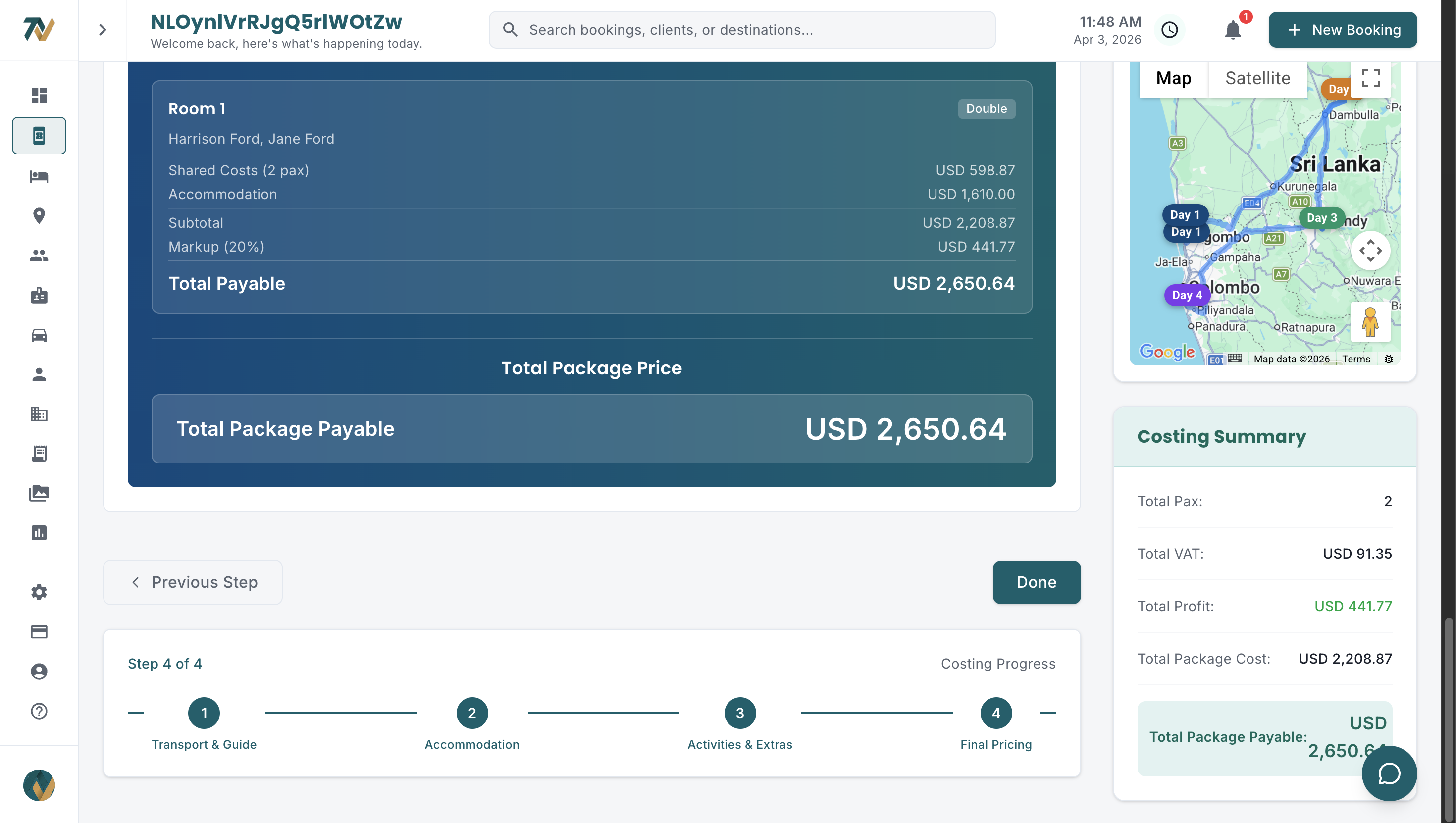
Vehicle rates multiply the work because the cost per kilometre depends on the vehicle type, and most Sri Lankan DMCs quote several types. The ranges below are illustrative; your supplier contracts set the real figures.
| Vehicle type | Typical use | Illustrative rate (LKR/km) | Illustrative rate (USD/km) |
|---|---|---|---|
| Car (sedan) | Couple or solo traveler | 55–75 | $0.17–$0.23 |
| Van (9-seater) | Small family or group of 4–6 | 75–100 | $0.23–$0.31 |
| SUV (Land Cruiser) | Premium clients, wildlife areas | 100–140 | $0.31–$0.43 |
| Mini coach (15–20 seats) | Small groups | 120–160 | $0.37–$0.49 |
| Full coach (40+ seats) | Large groups | 180–250 | $0.55–$0.77 |
When a travel agent asks for car, van and SUV options, every leg is costed three times at three rates: an eight-leg itinerary becomes 24 calculations, and errors become almost guaranteed.
What if your fleet does not match the standard vehicle categories?
Standard categories do not cover every fleet: a high-roof van that costs more than a standard one, a luxury coach priced separately, a tuk-tuk for Galle Fort transfers, or a 4x4 kept for Horton Plains runs. Forcing those into the nearest bucket misprices them on every costing.
In Travify, admins define custom vehicle types in Company Preferences alongside the standard set, each with a name and its own LKR-per-kilometre rate. Custom types appear in the vehicle dropdown on every costing, their rate is applied to the calculated distance, and they are labelled correctly on the costing review and summary.
How does automatic mileage calculation work in tour costing software?
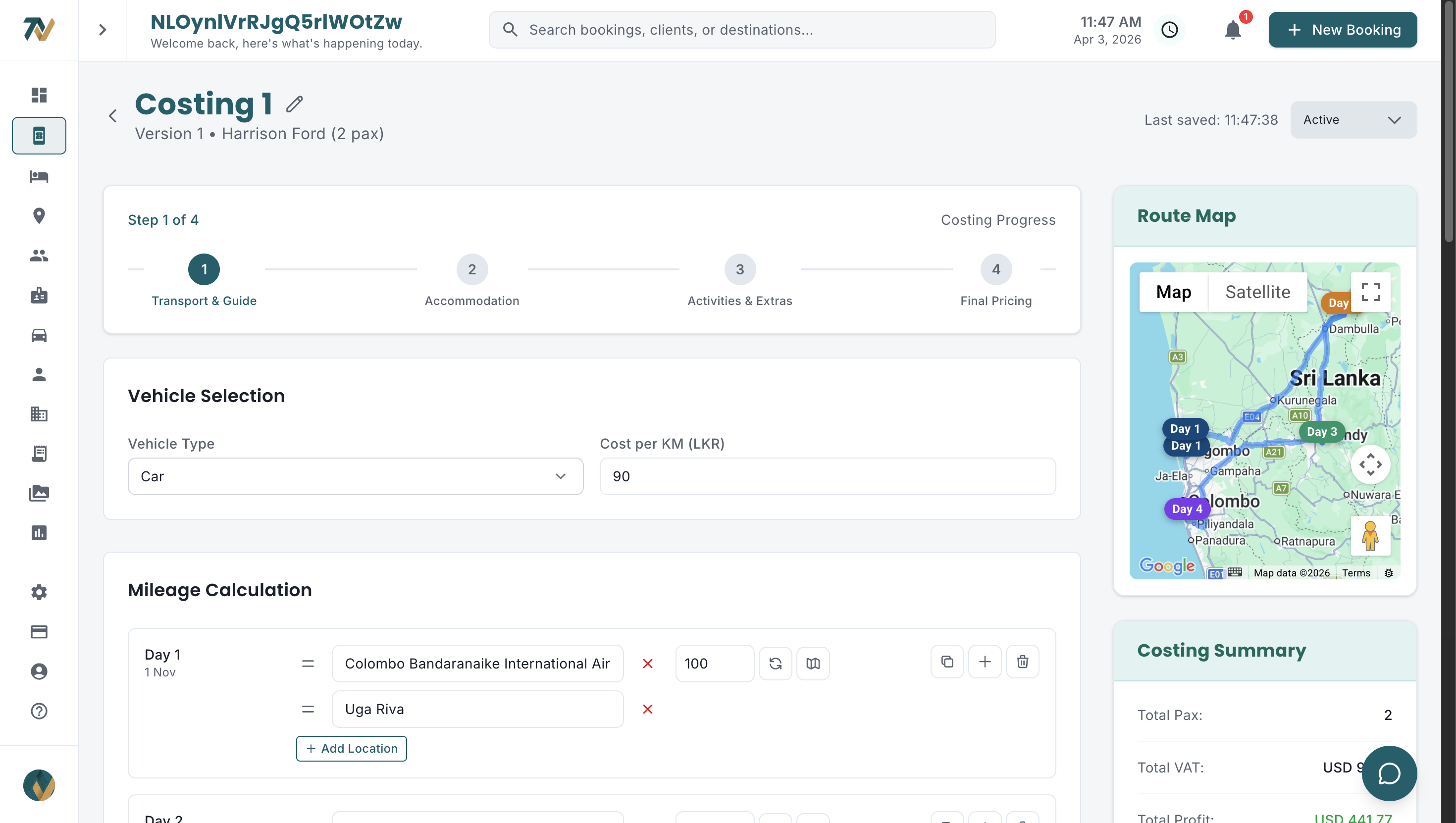
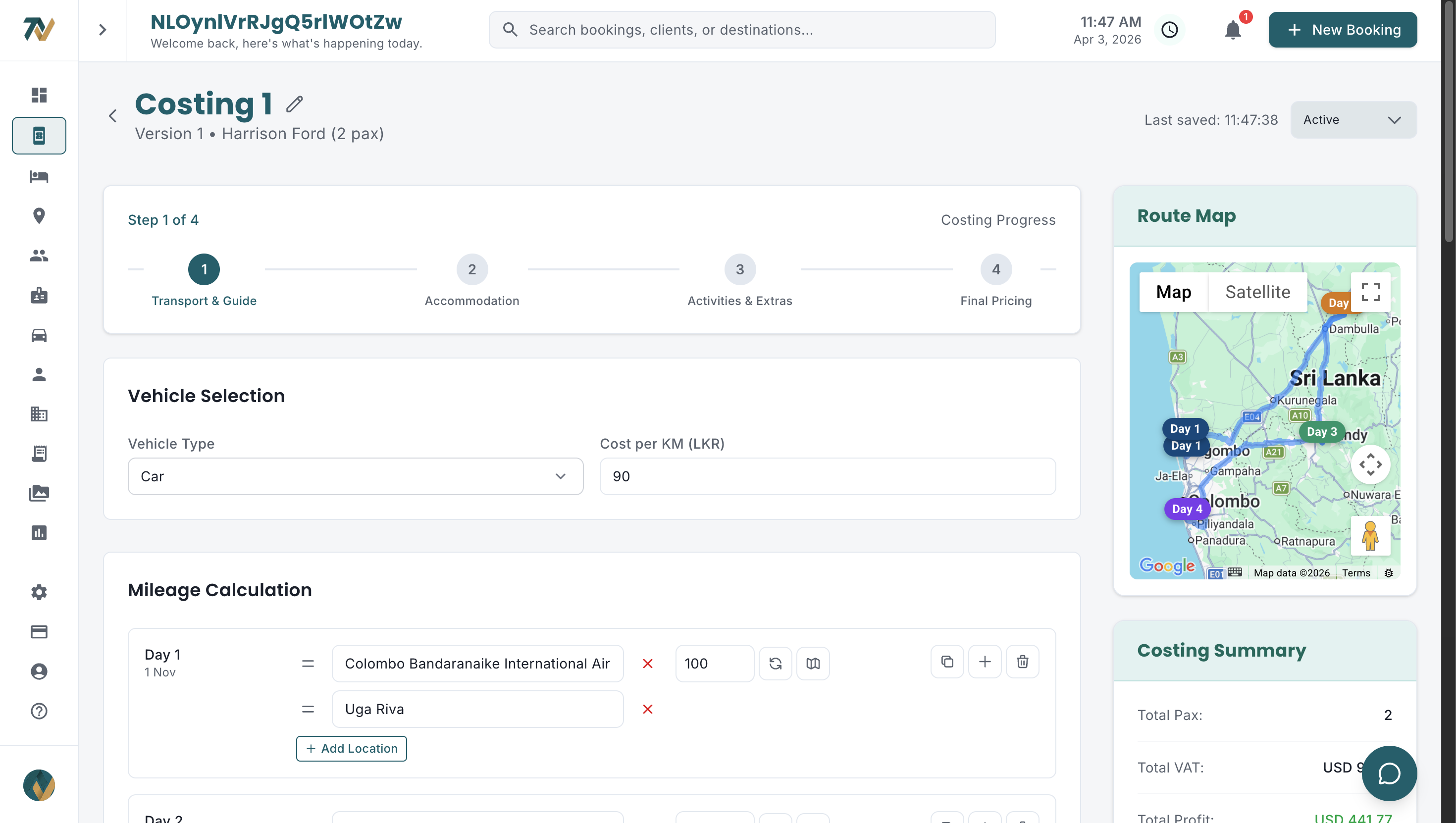
Automatic mileage calculation replaces the lookup with road routing: you list each day’s stops, the software works out the driving distance between them on real roads, adds your buffer, applies the vehicle rate and feeds the result into the tour costing.
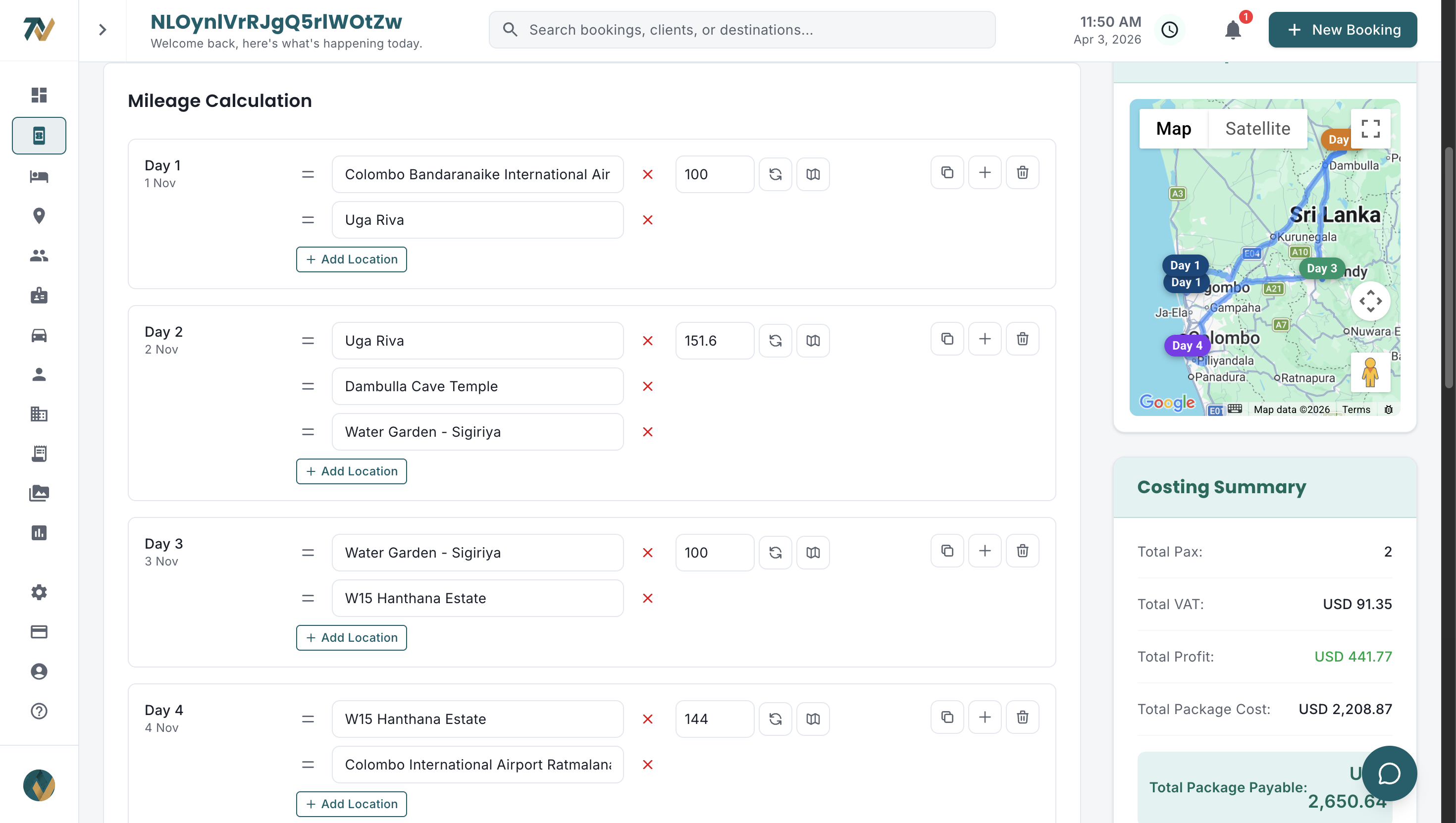
- Build the itinerary by selecting each day’s locations: hotels, activity sites, restaurants, viewpoints.
- The system calculates the driving distance between consecutive stops on real road routes, not straight lines.
- A buffer distance is added for detours and access roads (in Travify a company default in kilometres, adjustable per costing).
- Total distance is multiplied by the per-kilometre rate for the chosen vehicle type.
- Switch the vehicle type and the transport cost recalculates at the new rate.
- The transport total flows into the overall tour costing with no manual data entry.
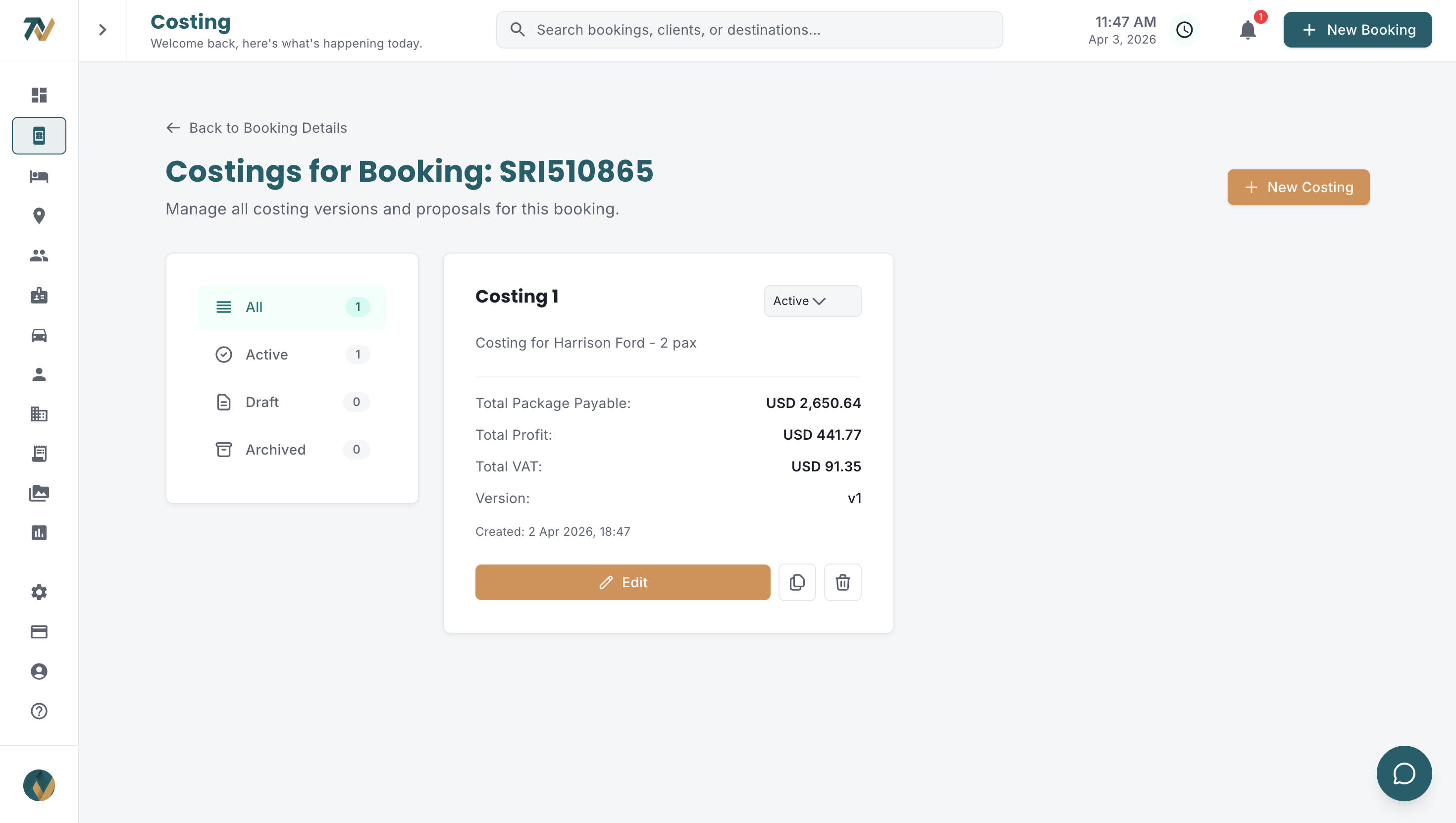
Distances are easy to keep current as the itinerary changes: add a Nuwara Eliya stop between Kandy and Ella and recalculate that day; swap the Galle hotel for one in Unawatuna and the day’s distance is recomputed in one click. Each day also has a “View on map” button that opens the route on a Google map with the stops in order and the day’s distance. The rest of the costing (hotels, guides, activities, markup, VAT) is covered in the complete guide to tour package costing.
Configure the LKR-per-kilometre rate for each vehicle type in Company Preferences. When supplier rates change, update them in one place; every new costing starts from the current rate, while costings already saved keep the per-kilometre rate they were quoted with: the rate is stored on the costing itself and changes only if you re-select the vehicle type or edit the Cost per KM field on that costing.
How are multi-stop days like a Kandy city tour costed?
A multi-stop day is costed as a chain of legs, and automation sums the chain. A typical Kandy day runs hotel pickup, Temple of the Tooth, the Royal Botanical Gardens at Peradeniya, a gem museum, a hilltop lunch, a spice garden and back to the hotel: six legs in one day.
With automatic calculation you list the stops in order and calculate the day; the system costs each leg and gives the day’s transport cost, with the buffer added once on the costing total. Drop the gem museum, recalculate the day and the cost updates.
Travify handles multi-stop days natively. Add as many stops as a day needs; the costing calculates the complete route with the distance between each point, adds your buffer mileage and applies the chosen vehicle’s per-kilometre rate.
Why do driving times matter more than distances in Sri Lanka?
Driving times matter because Sri Lanka’s distances are deceptive: Kandy to Ella and Colombo to Galle are similar distances on paper, yet the winding hill-country road takes more than twice as long as the Southern Expressway run. Seeing the route with distances and driving times between stops helps you build sensible driving days.
The same view helps clients: a travel agent or direct customer who sees the route with times asks fewer “how far is Ella from Kandy?” questions and arrives with realistic expectations.
What is the return on automating transport costing?
The return comes from the hours no longer spent on lookups and the margin no longer leaked through errors, and the second is usually the bigger win. The table continues the illustrative example; your own numbers will differ.
| Metric (illustrative example) | Manual process | Automated process | Saving |
|---|---|---|---|
| Mileage time per itinerary | 15–20 min | No manual lookups | 15–20 min |
| Itineraries per week (peak) | 15–20 | 15–20 | — |
| Weekly time saved | — | — | 4–7 hours |
| Mileage errors | Frequent: missed legs, wrong rates | Rare: distances and rates applied automatically | Near elimination |
| Cost impact of errors | $30–50 per booking | Negligible | $30–50 per booking |
| Season-long margin recovery | — | — | $1,500–$2,500+ |
Most operators underestimate the loss because each error is small and never appears on one report. It shows only when quoted costs are compared with actuals per booking, which is what settlement and profit tracking is for.
Compare the transport cost you quoted with what the driver actually invoiced. If actuals are consistently higher, you have a mileage calculation problem; even a small systematic underestimation adds up to real money over a full season.
Which transport costs besides mileage should a tour costing include?
A complete transport costing covers waiting time, tolls, driver accommodation and meals, night surcharges and vehicle premiums on top of base mileage. These extras decide whether the quote matches the driver’s final invoice.
- Waiting time: when a vehicle waits several hours at an activity site, some operators charge a waiting fee.
- Toll roads: the Southern Expressway and Central Expressway carry toll charges that belong in the costing.
- Driver accommodation and meals: on multi-day tours the driver’s overnight costs and meal allowances add to the total.
- Night driving surcharges: some vehicle operators charge extra for late-night airport pickups or departures.
- Vehicle condition premiums: newer or premium vehicles, such as luxury vans and late-model SUVs, command higher rates.
Capturing these alongside base mileage gives a true transport expense per booking. Guide and vehicle management covers keeping driver, guide and vehicle details ready for the costing.
How Travify calculates transport costs automatically
Travify’s guided costing has a transport step that calculates distance and mileage automatically by vehicle type, using per-kilometre rates you configure once. The workflow:
- Automatic mileage per day: list the day’s stops; the costing works out the road distance, adds your default buffer mileage (kilometres, adjustable per costing) and applies the LKR-per-kilometre rate of the chosen standard or custom vehicle type, with a “View on map” button per day that shows the route and its distance on a Google map.
- One costing, full picture: the transport total sits beside hotels, guides’ daily rates, activities and other expenses; markup % and VAT are applied, and a per-costing LKR to USD rate produces the USD selling price.
- Vehicle options in one click: duplicate a costing to quote a car, van or SUV variant; Draft, Active and Archived versions keep one Active price per booking.
- Quoted versus actual: a confirmed booking goes to the Transport department, which assigns a guide and vehicle with free/busy checks and closes the tour with odometer readings and extra expenses, creating a Finance payable that feeds the settlement.
Transport costing is one step of the wider Travify operations platform. Plans start at $24 per month for a two-user Solo team, and every plan starts with a free trial.
Stop wasting hours on manual mileage calculation
Travify’s route-based transport costing calculates distances automatically, applies vehicle-specific rates and recalculates each day’s distance in one click as you build the itinerary. Start your free trial and let your team sell tours instead of checking Google Maps.
Start your free trialarrow_forwardFrequently asked questions
Ready to Streamline Your Operations?
Join Sri Lankan travel companies already saving hours every week with Travify.
Related Articles
Tour Package Costing: Step-by-Step Guide for Sri Lankan DMCs
Every cost component of a Sri Lankan tour package, worked on a 7-night, 2-pax circuit: hotels, mileage, activities, guides, supplements, markup, VAT and currency conversion, with the formulas in the right order.
Tour Costing Errors: What They Really Cost a Sri Lankan DMC
A wrong hotel season, a missed half-board supplement, a forgotten park fee: small tour costing errors compound into lost margin on every booking. Here is what they cost Sri Lankan DMCs and how to stop them.
Guide and Vehicle Management Software for Sri Lankan DMCs
Most Sri Lankan DMCs run guides and vehicles from notebooks, WhatsApp groups and memory. It works until peak season, when it fails at the worst time. Here is what to record and how to assign without clashes.