
Tour Package Costing: Step-by-Step Guide for Sri Lankan DMCs
Every cost component of a Sri Lankan tour package, worked on a 7-night, 2-pax circuit: hotels, mileage, activities, guides, supplements, markup, VAT and currency conversion, with the formulas in the right order.
Travify Team
Travel Operations Experts · April 13, 2026 · Updated October 6, 2026
In short: To cost a Sri Lankan tour package, total every supplier cost in LKR: hotel nights by season, room type and meal plan; vehicle kilometres at a per-km rate; per-person and per-group activities; guide days; and any supplements. Add a contingency, apply your markup percentage, then VAT, and convert the total to a USD selling price at a buffered exchange rate. Build the smallest group size first and duplicate it for larger groups.
Tour package costing is the process of totalling every supplier cost in a trip, then adding margin and tax to reach a selling price. For a Sri Lankan DMC (destination management company, the inbound tour operator that builds and runs tours on the ground for overseas travel agents), the costing decides whether a booking earns money or quietly loses it.
This guide works through each component on one running example: a 7-night circuit for 2 pax from Colombo to Sigiriya, Kandy, Nuwara Eliya, Yala and Galle. Every rate, range and percentage below is an illustrative example of typical market pricing, not a tariff; check your own contracts before reusing a figure. If you still cost in spreadsheets, read why Excel is killing your tour costing first.
Key takeaways
- Accommodation is usually the largest cost in a Sri Lankan package, so cost it per room per night, matched to the rate season and meal plan of each stay.
- Transport cost equals total kilometres, including a buffer of around 10-15% for local driving, multiplied by the vehicle's per-km rate in LKR.
- Activities are priced per person (entrance fees) or per group (jeep safaris, boat charters); treating a per-group cost as per-person overprices small groups.
- The calculation order is fixed: supplements, discounts, contingency, markup, VAT, then one LKR to USD conversion on the total.
- Build the 2-pax costing first and duplicate it for 4 and 6 pax; only the per-person share of fixed costs changes.
How do you cost accommodation for a Sri Lanka tour package?
Cost accommodation per room per night, matched to the rate season of the travel dates and the meal plan the package is sold on. It is usually the largest single component of a Sri Lankan tour package, so a mistake here moves the final price more than any other line.
Room types and occupancy
Sri Lankan hotels price several room categories, and the costing must name the one the client will actually get:
- Standard or Superior room: the base category, usually adequate for mid-range tours
- Deluxe room: upgraded furnishings, sometimes better views or more space
- Suite or Junior Suite: the premium category for luxury itineraries
- Villa or Bungalow: standalone units, common in boutique properties and wildlife lodges
Then work out how many rooms the pax count and traveller composition require: a couple needs one double or twin room, a family of four may need one room with extra beds or two rooms, and six friends may need three twin rooms. Each configuration changes the total.
Seasonal rates
Sri Lankan hotel rates change by season, and most properties run at least two rate tiers; many run three or four. The table is an illustrative example of how the tiers typically relate to the peak rate.
| Rate season | Typical period | Rate relative to peak |
|---|---|---|
| Peak/High season | December - March | Full rack rate (100%) |
| Shoulder season | April - May, October - November | 70-85% of peak rate |
| Low/Green season | June - September | 50-65% of peak rate |
| Festive supplement | Dec 20 - Jan 5 (approx) | Peak rate + $20-$80/night supplement |
Always check which rate period each night falls into. A 10-night itinerary running from late November into December crosses from shoulder into peak season, so the same hotel needs two rate tiers. Missing that transition is one of the most common costing errors, and one reason hotel rate management deserves its own system rather than a folder of PDFs.
Meal plans
Hotel rates are quoted on one of five meal plan bases, and the abbreviation decides what the package still has to pay for:
- BB (Bed and Breakfast): breakfast only, the most common base rate
- HB (Half Board): breakfast and dinner, the standard for most Sri Lankan tour packages
- FB (Full Board): all three meals, common for luxury or all-inclusive packages
- AI (All Inclusive): meals plus beverages and sometimes activities, resort-specific
- RO (Room Only): no meals, rarely used in tour packages
Most Sri Lankan tour packages are sold on HB. If a hotel quotes BB, add the dinner supplement per person per night. As an illustrative range, that supplement runs around $8-$25 per person at mid-range hotels and $25-$60 at luxury properties.
Cost accommodation per night, never per stay: two nights at $120 is $240. Across five properties it is easy to mix up per-night and per-room-per-night rates, so confirm whether a quoted rate is per room or per person. Most Sri Lankan hotels quote per room per night on double occupancy.
Sample accommodation costing
| Night | Location | Hotel | Room type | Meal plan | Rate per night | Nights | Total |
|---|---|---|---|---|---|---|---|
| 1-2 | Sigiriya | Hotel A | Deluxe | HB | $95 | 2 | $190 |
| 3-4 | Kandy | Hotel B | Superior | HB | $85 | 2 | $170 |
| 5 | Nuwara Eliya | Hotel C | Deluxe | HB | $110 | 1 | $110 |
| 6 | Yala | Hotel D | Chalet | FB | $145 | 1 | $145 |
| 7 | Galle | Hotel E | Suite | HB | $120 | 1 | $120 |
Accommodation for the 7-night example totals $735 for one room. For 2 pax sharing, that is the full room cost; if the travellers need separate rooms, double it.
How do you calculate transport and mileage costs in Sri Lanka?
Transport cost is total kilometres multiplied by the vehicle's per-km rate in LKR, plus a buffer for local driving. Most Sri Lankan tours use one private vehicle with a dedicated driver for the whole trip, so transport is normally the second-largest cost after hotels.
Vehicle types and per-km rates
Per-km rates rise with vehicle size. The bands below are illustrative; your own fleet or transport suppliers set the real figures.
| Vehicle type | Capacity | Typical use | Illustrative rate per km |
|---|---|---|---|
| Car (Sedan) | 2-3 pax | Couples, solo travellers | LKR 55-75 |
| SUV | 3-4 pax | Families, small groups | LKR 70-95 |
| Van (Mini) | 4-6 pax | Small groups, families with children | LKR 85-110 |
| Van (Hi-Ace) | 6-10 pax | Medium groups | LKR 110-140 |
| Coach (Mini) | 10-20 pax | Large groups, incentive tours | LKR 150-200 |
| Coach (Full) | 20-45 pax | Large groups, series tours | LKR 200-300 |
Calculating mileage
The formula is Total km x Rate per km = Transport cost. The work is in getting the kilometres right:
- Measure the actual driving distance between each stop on the itinerary with a mapping tool
- Add buffer mileage, typically 10-15%, for detours, local driving within destinations, airport transfers and restaurant stops
- Include the driver's return journey when the drop-off point differs from the pick-up point
- Add empty-leg distances, for example the vehicle positioning from Colombo to the airport without passengers
For the 7-night example, the approximate segment distances are:
| Segment | Distance (km) | Notes |
|---|---|---|
| Airport to Sigiriya | 175 | Via Colombo bypass |
| Sigiriya to Kandy | 90 | Including Dambulla stop |
| Kandy to Nuwara Eliya | 80 | Via Ramboda |
| Nuwara Eliya to Yala | 195 | Via Ella or direct route |
| Yala to Galle | 175 | Coastal route |
| Galle to Airport | 165 | Via expressway |
| Buffer (12%) | 105 | Local driving, detours |
| Total | 985 |
At an illustrative car rate of LKR 65 per km, transport for 985 km costs LKR 64,025, roughly $200 at LKR 320 to the US dollar, covering vehicle and driver for the whole trip. Doing this by hand for every quote is slow and error-prone: the hidden cost of manual mileage calculation.
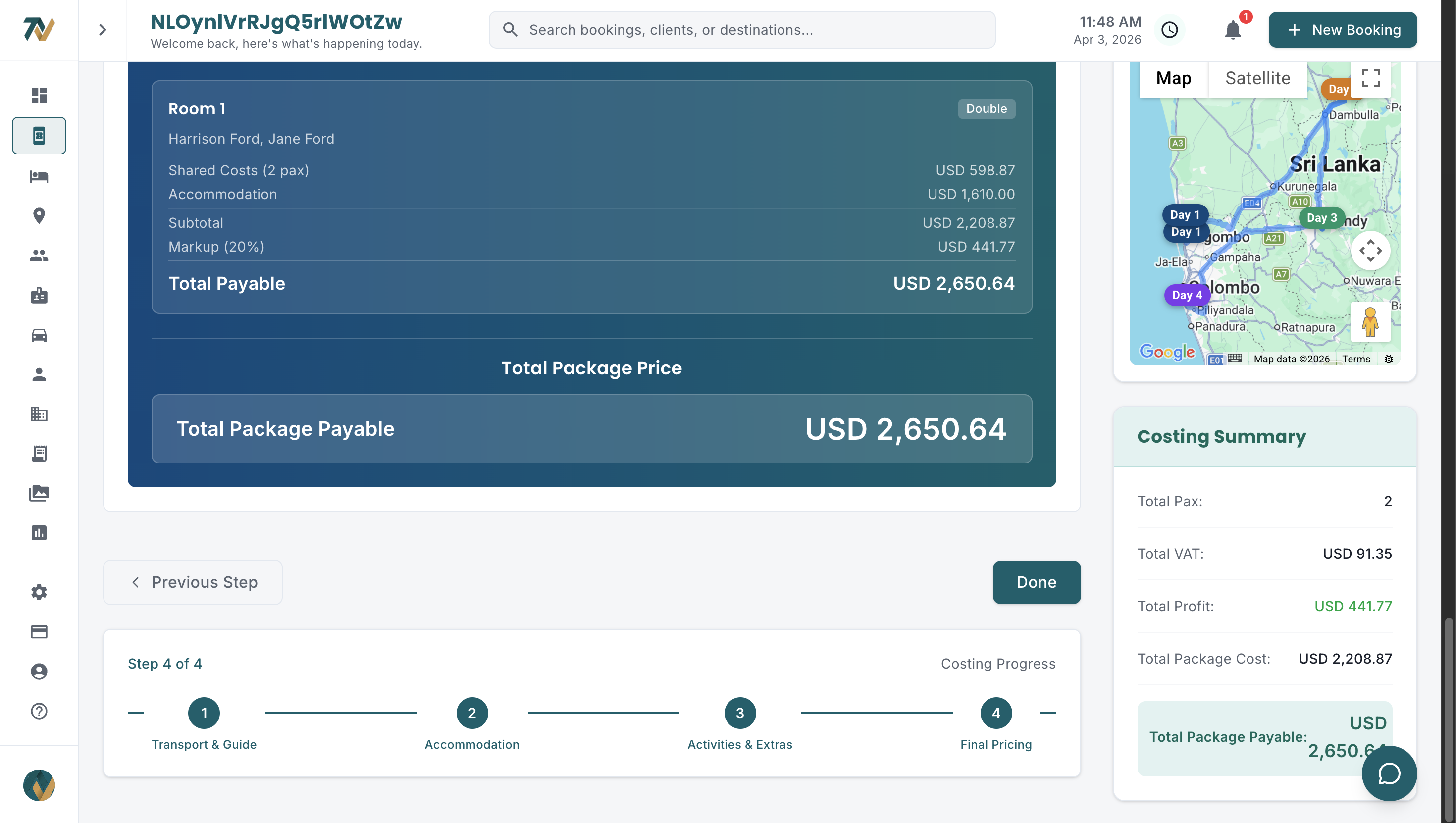
Some DMCs use a per-day vehicle rate instead of per-km pricing. Per-km is usually more accurate and more transparent, especially when daily distances vary widely. Whichever method you choose, apply it consistently across every costing.
How do you cost activities, entrance fees, guides and meals?
Cost each activity as a per-person or a per-group item, cost guides by the day, and either cost meals the hotel plan does not cover as an allowance or leave them to the client. Confusing per-person with per-group pricing is the most common activity costing error.
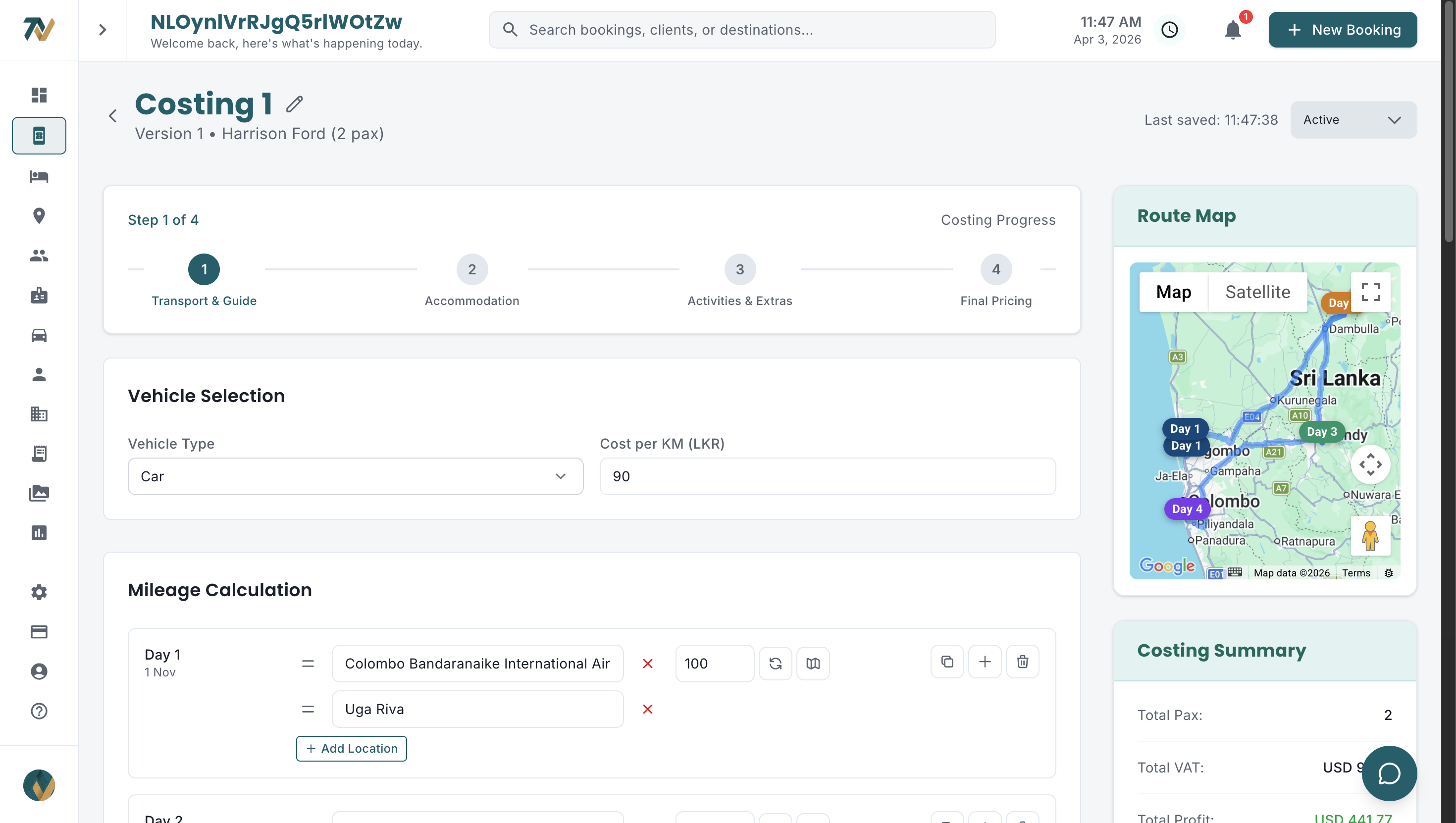
Per-person versus per-group activities
Sri Lankan activities, entrance fees and excursions are priced in two distinct ways:
- Per person: entrance fees (Sigiriya, Yala National Park tickets), cooking classes, spa treatments, guided walks
- Per group: jeep safaris (per vehicle, not per person), boat charters, private guided tours, vehicle-based excursions
The distinction matters. A Yala safari jeep costs the same whether it carries 2 or 6 passengers (illustratively $50-$65 per jeep), so costing it per person inflates small-group prices. Sigiriya entrance, by contrast, is a true per-pax cost that scales with group size.
| Activity | Pricing type | Illustrative cost | For 2 pax | For 6 pax |
|---|---|---|---|---|
| Sigiriya entrance | Per person | $30/pax | $60 | $180 |
| Yala jeep safari | Per group | $55/jeep | $55 | $55-$110 (may need 2 jeeps) |
| Kandy cultural show | Per person | $10/pax | $20 | $60 |
| Whale watching (Mirissa) | Per person | $40/pax | $80 | $240 |
| Cooking class | Per group (up to 4) | $65/group | $65 | $130 (2 groups) |
| Galle Fort walking tour | Per group | $25/group | $25 | $25 |
Keep a reusable catalogue of the activities you include most often, with current pricing, pricing type (per person or per group) and capacity limits. It saves time on every costing and stops outdated prices creeping in. Travify's expense catalogue does exactly this: add an activity once and it is available on every future costing, pricing pre-configured.
Guide fees
Guide services in Sri Lanka come in two forms, and the choice changes both cost and vehicle requirements:
- Chauffeur-guide: the driver doubles as guide. The usual arrangement for couples and small groups, included in the transport cost or charged as a daily supplement.
- Dedicated guide: a separate professional guide travels with the group while a driver handles the vehicle. Standard for larger groups, luxury tours and languages such as Japanese, Mandarin or French.
Dedicated guides are paid a daily rate that varies with language, experience and season; as an illustrative range, $40-$80 per day, rising to $100-$120 for specialist language guides in peak season. The DMC usually also covers the guide's accommodation and meals, through hotel arrangements or as a separate cost line.
Meals outside the hotel plan
On an HB tour, lunches are not in the hotel cost, so decide how to treat them:
- Include a fixed lunch allowance per person per day (illustratively $8-$15 for mid-range and $15-$25 for premium tours)
- Leave lunches as a client expense, the usual choice for FIT tours (free independent travellers: private, tailor-made trips rather than group departures) where flexibility matters
Group tours and all-inclusive packages need meals costed explicitly. Enter special dining, such as a rice and curry dinner in a local home or a seafood dinner in Galle, as separate activity lines.
Which supplements and discounts change a tour package price?
Supplements are conditional extra charges and discounts are conditional reductions; apply supplements first, then discounts, so each discount is calculated on the correct base. Common supplements in Sri Lankan tour costing:
- Single room supplement: when a solo traveller occupies a double room, illustratively 40-70% of the room rate
- Festive season supplement: an additional nightly charge over Christmas and New Year
- Peak season surcharge: some properties charge above their published high-season rate on specific dates
- Extra bed supplement: for triple occupancy or children needing additional beds
- Special diet supplement: for specific dietary requirements at certain properties
Discounts include early booking discounts (illustratively 5-15% for bookings made 90 or more days ahead), long-stay discounts for three or more nights at one property, repeat client discounts and agent-specific negotiated rates.
How do you calculate markup, VAT and the USD selling price?
Selling price = (total cost + contingency) x (1 + markup %) x (1 + VAT %), converted from LKR to USD once, at the end, at a buffered exchange rate. Markup comes before VAT, and conversion happens on the total, not line by line.
Markup
Markup is the gross margin on the package. It has to cover operating costs (office, staff, marketing, software) and still leave a net profit. Ranges differ by tour type; the table is illustrative, not a benchmark.
| Tour type | Illustrative markup range | Notes |
|---|---|---|
| Budget/Backpacker | 10-15% | High volume, low margin |
| Mid-range FIT | 15-22% | Standard market range |
| Luxury FIT | 20-30% | Higher service expectations, lower volume |
| Group series | 12-18% | Volume-based, negotiated rates |
| MICE/Incentive | 18-25% | Complex logistics, higher risk |
| Honeymoon/Special occasion | 20-28% | Premium positioning, customisation |
The formula: Selling price = Total cost x (1 + Markup %). If total cost is $2,500 and markup is 20%, the selling price is $3,000 and gross profit is $500. For how markup interacts with agent commission and competitor pricing, see how to price tour packages competitively.
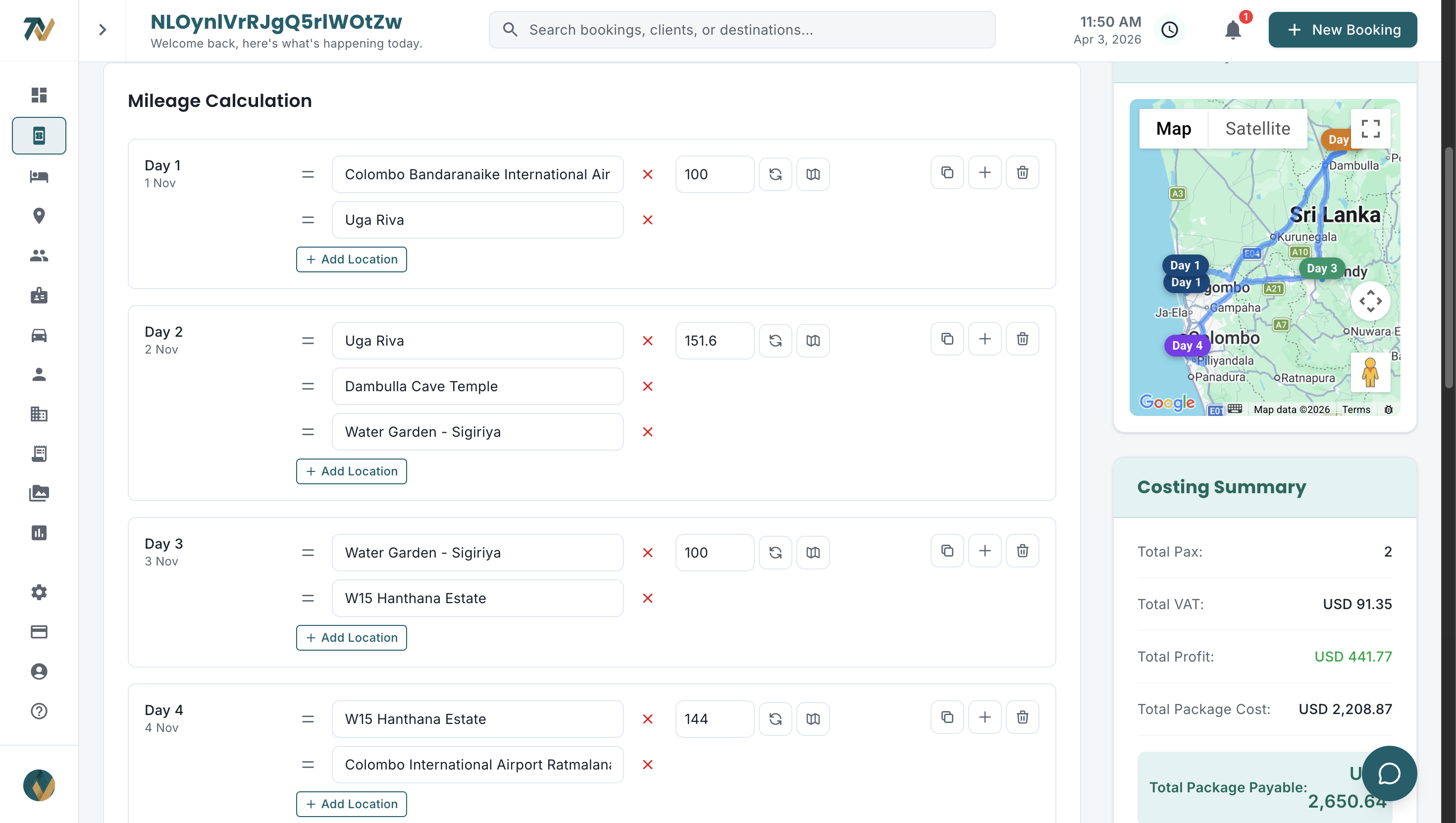
A common mistake is applying markup inconsistently: one rate on accommodation, another on transport, a third on activities. Differentiated margins can be deliberate strategy, but inconsistency usually signals a missing methodology. Set a default markup, apply it everywhere, then adjust for specific competitive situations.
VAT
Sri Lankan tourism services are subject to VAT, applied to the marked-up selling price: Final price = Selling price x (1 + VAT %). VAT goes on after markup, never before; applying it to cost first under-collects the tax, and that error lands straight on your margin, as the real cost of tour costing errors shows.
Some DMCs absorb VAT inside their markup and quote VAT-inclusive prices; others add it explicitly. Both are valid if applied consistently and the markup is large enough to cover VAT when absorbed. In Travify the VAT percentage is set per costing alongside the markup, and the Final Pricing step's cost breakdown shows each section's total before VAT, the VAT amount and the total with VAT, with Total VAT listed separately in the Costing Summary.
Currency conversion
Most Sri Lankan DMC costs are incurred in LKR, while selling prices to international travel agents are usually quoted in USD. The conversion step carries exchange-rate risk, so manage it deliberately:
- Use a conversion rate with a buffer above the current market rate (illustratively 1-3%) for fluctuations
- Update the rate regularly: at least weekly in volatile periods
- Convert once, after all LKR costs are totalled and marked up, not at line-item level
- Keep USD-quoted hotel costs in USD throughout to avoid double conversion
If a costing totals LKR 800,000 at LKR 320 to the dollar, the cost is $2,500; after 20% markup, $3,000; after VAT, the final selling price to the agent. For managing exchange-rate risk in quotes, see multi-currency tour pricing.
Travel agents often ask for 2, 4 and 6 pax prices. The per-person price falls as the group grows because fixed costs (vehicle, per-group activities, guide days) are spread across more people. Build the smallest group first, then duplicate and adjust. In Travify a costing duplicates in one click, and alternatives sit as Draft versions beside the single Active version.
What does a complete 7-night Sri Lanka tour costing look like?
Put together, the 7-night, 2-pax example costs $1,240 before markup and sells for $1,488 plus VAT, about $744 per person. Every figure is illustrative.
| Cost component | Amount (USD) | Notes |
|---|---|---|
| Accommodation (7 nights) | $735 | 1 room, HB basis |
| Transport (985 km, car) | $200 | Including 12% buffer |
| Activities | $305 | All six lines from the activity table, 2 pax |
| Guide fees (8 days) | $0 | Chauffeur-guide included in transport |
| Lunches | $0 | Client expense on HB tours |
| Supplements | $0 | No single supplement in this example |
| Total cost | $1,240 | Before any contingency |
| Markup (20%) | $248 | |
| Subtotal | $1,488 | |
| VAT | As applicable | Applied at the current rate |
| Per person price | $744 plus VAT | 2 pax sharing one room |
How does Travify handle each tour costing step?
Every step above (hotel rates, mileage, activities, guides, markup, VAT and conversion) happens inside Travify's guided multi-step costing rather than across spreadsheets and calculators:
- Hotel rates come from the Rate Document Library: upload a contract or rate sheet, AI extracts seasonal rates by date range, occupancy prices, meal plans and cancellation terms, and the saved rate is picked inside the costing, where the rate picker can also show the stay's free-cancellation cutoff read from the hotel's saved policies
- Transport mileage is calculated automatically from the route by vehicle type, with configurable per-km rates in LKR, including custom vehicle types you add yourself with their own names and per-km rates
- Activities come from the expense catalogue, with per-person and per-group pricing handled correctly
- Markup percentage and VAT are set per costing and applied automatically; agent commission can be set per costing too
- All costs stay in LKR and a per-costing LKR to USD rate produces the USD selling price; the client-facing itinerary can show prices in the client's home currency at a rate frozen on the costing
- Pricing tiers for 2, 4 and 6 pax come from one-click duplication, with Draft, Active and Archived versions and only one Active
- AI auto-fill drafts the whole costing from a typed or dictated description, or in one click from the booking, for your review; the costing still does the pricing arithmetic
- Changes save automatically as you work and team notes live on the costing; the branded day-by-day itinerary is built from it, and an invoice can be built from it with a line item seeded at the costing's VAT-inclusive total
See the full costing workflow on the solutions page, or compare plans on the pricing page; every plan starts with a free trial.
Build your first costing in Travify
Stop spending hours on manual tour costing. Start a free trial and see how a dedicated costing system handles the arithmetic so you can focus on designing great tours.
Start your free trialarrow_forwardFrequently asked questions
Ready to Streamline Your Operations?
Join Sri Lankan travel companies already saving hours every week with Travify.
Related Articles
Excel Is Killing Your Tour Costing: Why DMCs Need Software
Excel was never designed for tour costing. Sri Lankan DMCs lose margin to silent formula errors, waste hours hunting rates and risk bookings on version confusion. Here is what dedicated costing software does differently.
How to Price Tour Packages Competitively and Protect Margin
Price pressure and rising costs are squeezing Sri Lankan DMC margins. Six practical pricing strategies, from accurate costing to settlement checks, that win bookings without giving away profit.
Hotel Rate Management for Sri Lankan DMCs: Fix the Chaos
If your hotel rates live in email inboxes, PDF attachments and WhatsApp threads, you are almost certainly quoting wrong prices. Here is how Sri Lankan DMCs centralise seasonal rates and stop the margin leak.