
How to Price Tour Packages Competitively and Protect Margin
Price pressure and rising costs are squeezing Sri Lankan DMC margins. Six practical pricing strategies, from accurate costing to settlement checks, that win bookings without giving away profit.
Travify Team
Travel Operations Experts · April 13, 2026 · Updated October 6, 2026
In short: Price tour packages from an accurate, current costing (hotels, mileage-based transport, guides, activities, VAT), then set markup by market segment and season rather than one flat rate. Model a standard, budget and premium costing version before quoting, answer price pushback with low-cost value-adds instead of discounts, and check every completed tour's settlement so real costs feed the next quote.
Sri Lanka's tourism market is growing fast. The island recorded 2.36 million tourist arrivals in 2025, up 15.1% year on year, with tourism revenue above $3.2 billion and a government target of 3 million arrivals in 2026. For a Sri Lankan DMC (destination management company: the local operator that costs, books and runs tours for overseas travel agents), the opportunity is real.
Margins are not growing at the same pace. The VAT increase from 15% to 18% in 2024 took three percentage points straight out of selling prices, hotel rates have risen with demand, fuel costs move constantly, and new operators keep entering the standard cultural-circuit market. Shaving a few dollars off the per-person rate to win a booking is a race to the bottom. The operators who thrive price strategically: they know their true costs, structure markup to protect margin, and use their own data to see where money is made and lost.
Key takeaways
- Accurate, current costs come first: a quote built on last season's hotel rates or estimated mileage loses margin before the tour starts.
- Markup is not margin: calculate margin after VAT, agent commission and overhead, and never absorb the 18% VAT into your markup.
- Segment markup by market and season instead of applying one flat percentage to a luxury honeymoon and a budget backpacker alike.
- Model a standard, budget and premium costing version before quoting so you can counter price pushback in minutes, not hours.
- Answer "too expensive" with a low-cost value-add or a different hotel mix, not a discount.
- Review every completed tour's settlement to find cost categories that consistently overrun, then correct the next costing.
Why does revenue growth not turn into profit growth for Sri Lankan DMCs?
Revenue grows with arrivals, but a DMC's margin is the thin slice left after hotels, transport, guides, activities, VAT and overhead, and each of those has risen faster than selling prices. The table below is an illustrative example of the economics of a 7-night Sri Lanka tour for two travelers; the figures are rounded assumptions, not industry benchmarks.
| Cost component | Illustrative LKR cost | Approx. USD | Share |
|---|---|---|---|
| Accommodation (7 nights, 4-star) | LKR 280,000 | $870 | 38% |
| Transport (1,200 km circuit, van) | LKR 120,000 | $370 | 16% |
| Activities and entrance fees | LKR 65,000 | $200 | 9% |
| Guide fees (7 days) | LKR 84,000 | $260 | 11% |
| Meals and supplements | LKR 50,000 | $155 | 7% |
| Miscellaneous (tips, permits, extras) | LKR 15,000 | $46 | 2% |
| Total direct cost | LKR 614,000 | $1,901 | 83% |
| Markup (20%) | LKR 122,800 | $380 | n/a |
| Subtotal before VAT | LKR 736,800 | $2,281 | n/a |
| VAT (18%) | LKR 132,624 | $411 | n/a |
| Selling price per person | n/a | $1,346 | n/a |
| Margin per person (before overhead) | n/a | $190 | 14% |
In this example, a 20% markup on direct costs leaves about $190 per person before overhead, roughly 14% of the selling price. Office rent, salaries, marketing and agent commission all come out of that figure, so the net margin on a standard booking is thin. One hotel rate entered incorrectly or one forgotten supplement can remove it entirely.
The 18% VAT is not optional and cannot be absorbed without damaging margin. Operators who quietly absorb part of the VAT to look competitive give away a slice of every booking. VAT must be built transparently into the pricing model as a line on top of cost plus markup.
How do you find the true cost of a tour package before pricing it?
Build every quote from a complete, current costing: contracted hotel rates for the actual travel dates, transport calculated from real kilometres by vehicle type, guide daily rates, activity and entrance fees, supplements and the small extras. Most DMCs instead work from approximate costs that were close enough last season and have not been updated since.
Costing errors that silently erode margin:
- Using last season's hotel rates after properties have raised prices for the new season (see why hotel rate management turns to chaos)
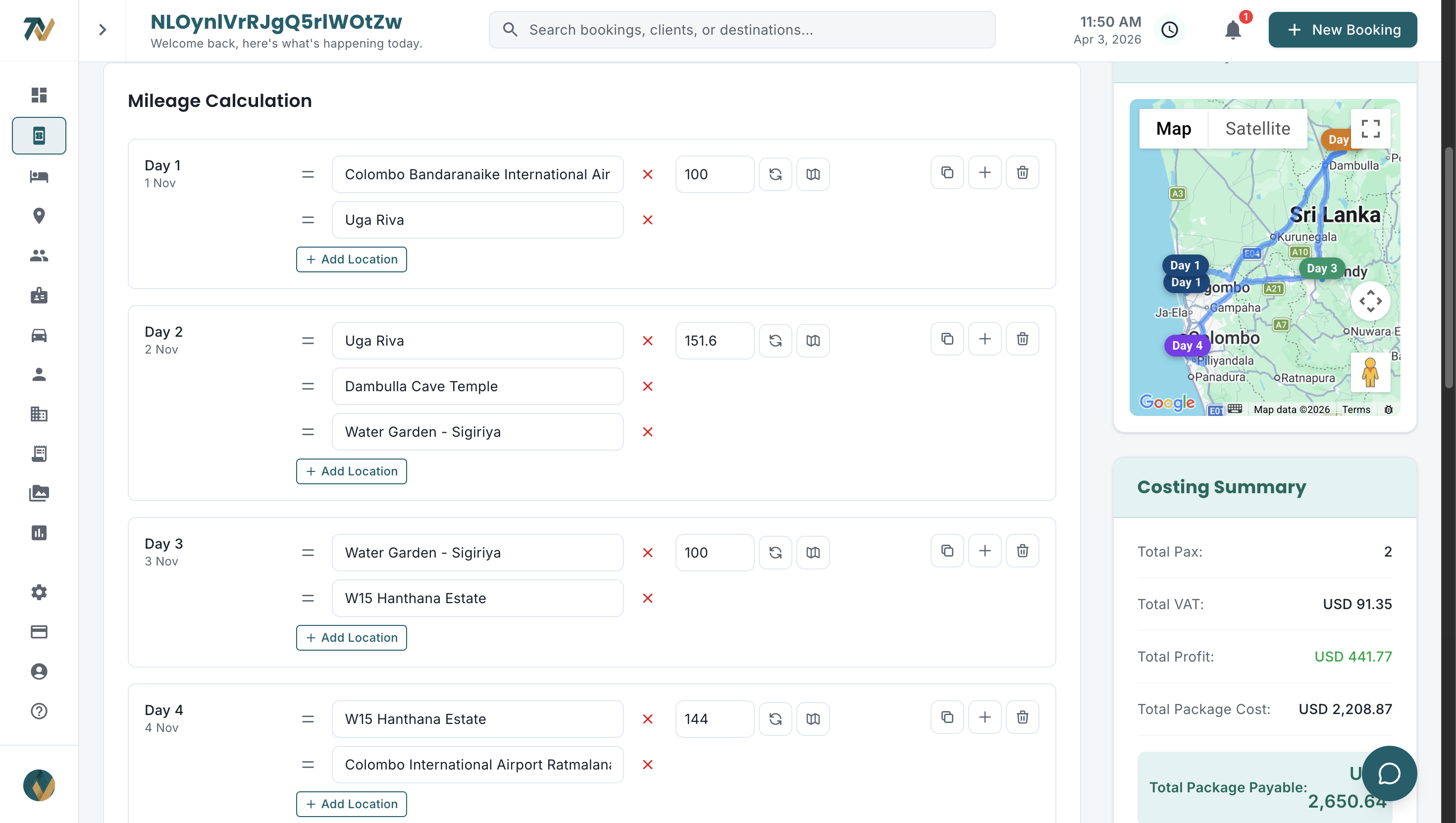
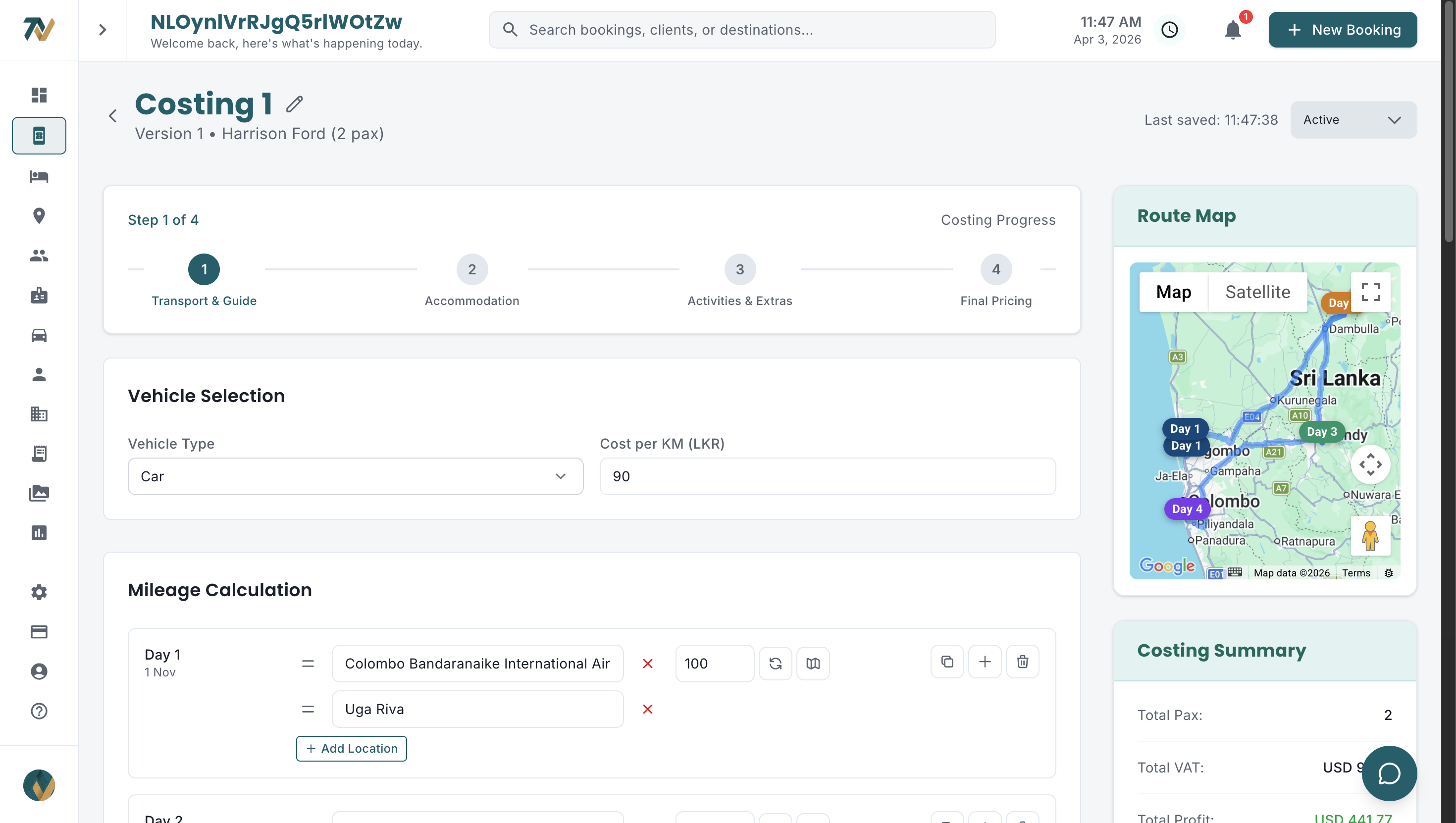
- Estimating transport instead of calculating actual mileage at current fuel-adjusted per-kilometre rates (the hidden cost of manual mileage calculation)
- Forgetting seasonal supplements: peak-season surcharges and compulsory Christmas and New Year gala dinners that hotels add in December and January
- Missing guide fee increases or vehicle rate adjustments that suppliers apply mid-season
- Applying one flat activity cost when the supplier prices by group-size tier
- Omitting small costs that add up: entrance fees outside the main activity, parking, tolls and mandatory tips at certain attractions
Rebuild the costing of your five best-selling itineraries from scratch with current rates each quarter and compare the result with the price you have been quoting. The gap between assumed and actual cost is usually larger than expected, and it comes directly out of margin.
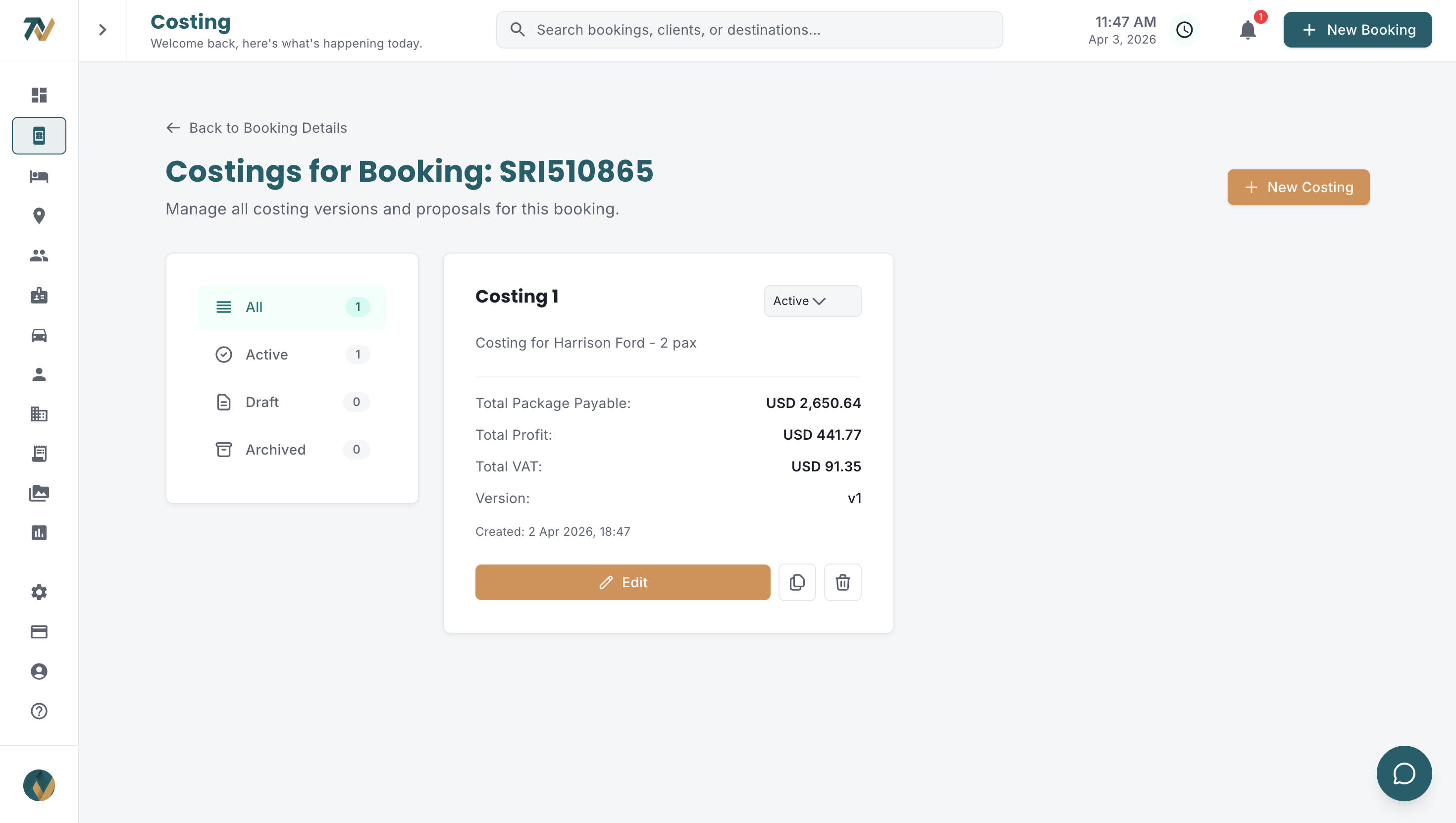
A structured costing tool removes most of these errors by keeping rates in one place. In Travify, seasonal hotel rates extracted from your contracts into the Rate Document Library are ranked against the stay (travel date inside the rate's season, plus meal plan, room category and occupancy) and one click fills the nightly price in the costing, transport is calculated from mileage by vehicle type at your own per-kilometre rates, and activities come from the expense catalog. For the full method, read the complete guide to tour package costing.
How do costing versions help you test pricing scenarios?
Costing versions let you price the same booking two or three ways and compare margin before you quote, instead of guessing whether a 15% or 22% markup will win the booking. In Travify, each booking holds multiple costing versions with Draft, Active and Archived statuses (only one is Active), and any version can be duplicated in one click.
- Standard version: your normal markup and hotel selection
- Budget version: swap 4-star hotels for well-rated 3-star alternatives and see exactly how far the price drops
- Premium version: upgrade properties and add exclusive experiences that justify a higher price point
- Compare the margin of each version side by side before committing to a quote
- Send the version that matches the agent's client profile and budget expectations
When an agent says the client likes the itinerary but the price is too high, you open the budget version and make an informed counter-offer, rather than recalculating under pressure.
How should a DMC segment tour pricing by market and season?
Set markup by segment and season, because a two-person luxury honeymoon from the UK and a 14-person budget group from India do not carry the same margin expectation. Segmentation lets you earn more where the market supports it and stay competitive where buyers are price-sensitive. The markup bands in the table are illustrative starting points, not industry benchmarks; calibrate them against your own settlements.
| Segment | Typical characteristics | Pricing approach | Illustrative markup band |
|---|---|---|---|
| Luxury / Boutique | 1-4 pax (passengers), high-end properties, private experiences | Value-based pricing with premium experiences that justify higher rates | 25-35% |
| Mid-range (Core) | 2-6 pax, 4-star hotels, standard circuit | Competitive pricing with accurate costing to protect margin | 18-25% |
| Budget / Backpacker | 1-2 pax, 3-star or homestays, self-guided elements | Volume-based with lean operations, minimal margin per booking | 12-18% |
| Group Series | 10-20+ pax, negotiated group rates, repeat departures | Supplier volume discounts passed partially to the client, retained partially as margin | 15-22% |
| MICE (meetings, incentives, conferences, events) / Corporate | Variable pax, conferences, team building | Premium pricing for coordination complexity and reliability | 22-30% |
Season matters as much as market. In the December to March peak, demand exceeds supply and you should price at the top of your range. In the shoulder months (April to May, September to November) competitive pricing protects booking volume, while the east coast (Trincomalee, Arugam Bay) runs its own May to September peak. In the June to August low season, selective discounting with a firm margin floor avoids a revenue drought without training agents to expect unsustainable prices. Our guide to handling the December to March peak covers the operational side.
Why track actual costs against planned costs after every tour?
Tracking actual against planned cost is the only way to know which itineraries are genuinely profitable, because delivered costs often differ from the costing: hotels bill extras outside the contracted rate, transport overruns when the client adds a detour, or a supplier raises prices after you quoted.
Without this check, a DMC can quote its most popular itinerary at a 20% markup while the delivered cost runs consistently over plan, and never see that the real margin is far lower.
In Travify, a settlement is created automatically when a booking is marked Completed. You enter the actual cost paid for each hotel, activity and guide (a closed tour's km cost, guide fee and extras can be imported from Transport), the settlement shows the planned cost from the costing beside each line and calculates the variance per line, per cost category and for the overall total (green under budget, red over), and it sets actual profit against the estimated profit. Finance payables (amounts owed to suppliers) are created separately when hotel vouchers are confirmed, supplier vouchers are sent and the tour is closed with odometer readings and extra expenses. Over time, patterns appear: transport on the Cultural Triangle route consistently over plan means your per-kilometre rate needs adjusting; a hotel that regularly bills extras needs its contract re-read. See settlement and profit tracking for the full workflow.
Settlement review is one of the highest-return habits for DMC profitability. Margin leakage from cost overruns is invisible until actual costs are compared with the costing, and once a category is identified the loss can be recovered by correcting the rate in the next costing.
How do you compete on value instead of cutting price?
When an agent pushes back on price, add perceived value that costs you little rather than reducing the quote. A discount comes straight out of margin; a value-add protects it and gives the agent something new to sell.
Low-cost value-adds that agents can sell
- A complimentary airport meet-and-greet with a garland and welcome drink: minimal cost, strong first impression
- A sunset drink at a scenic viewpoint such as the Galle Fort ramparts or Lipton's Seat: often free or very low cost, but a memorable moment in the itinerary
- A vehicle upgrade for one scenic day, for example an SUV on the Ella to Nuwara Eliya stretch: marginal cost, noticeable comfort
- A home-cooked meal or cooking class: low cost per person and high perceived value
- Flexible rebooking terms that cost nothing if unused but reassure agents and clients
- A personalised welcome note and printed itinerary at the first hotel: a professional touch that competitors rarely match
Keep a list of 10 to 15 low-cost, high-impact experiences for your destinations. When a negotiation starts, offer one or two of these instead of a price cut. Agents and clients respond better to added value than to a raw discount, and your margin stays intact.
Move up the value chain with high-value products
Sri Lanka's tourism policy is pivoting from volume to high-value tourism (luxury, wellness, eco-tourism and cultural experiences), and that gives a DMC room to move up the value chain instead of competing at the bottom. Wellness and Ayurveda travel is growing with global demand, and guests buying authentic Ayurveda retreats, yoga stays or boutique experiences are far less price-sensitive than the standard sightseeing traveler.
- Wellness itineraries that pair an Ayurveda retreat with cultural highlights, which command noticeably higher per-person rates than standard circuits
- Boutique partners (tea-estate bungalows, eco-lodges, heritage homes) built into a premium product line
- Multi-day wildlife beyond the standard Yala safari: Wilpattu, Udawalawe, Sinharaja and the Knuckles Range offer quieter, more premium experiences
- Sustainable and eco-conscious options positioned as premium products, not discounts; travelers increasingly pay more for responsible tourism, not less
What does a sustainable tour pricing model look like?
A sustainable pricing model is a discipline, not a magic number: every booking is priced from accurate costs, every margin has a floor, and every variance is fed back into the next quote. Start by removing the mistakes that cost the most margin, then follow a fixed routine.
Six pricing mistakes that erode DMC margin
- Racing to the bottom: matching the lowest competitor price without knowing their cost structure. They may be pricing below cost for market share, using subsidised rates or cutting service quality.
- Treating markup as margin: VAT is a pass-through that contributes nothing to profit. Calculate margin after all costs, including the VAT liability.
- One flat markup for every segment: the same 20% leaves money on the table with a luxury honeymooner and loses the budget backpacker.
- Not updating rates mid-season: a tour quoted on April rates and operated in July with revised hotel and fuel rates pays the difference out of margin.
- Absorbing agent commission into margin: a travel agent (the overseas B2B partner who sells your tours) expecting 10% commission on a 20% markup leaves you 10%, not 20%. Build commission into the costing; Travify lets you set agent commission per costing.
- Quoting without a complete costing: a quick estimate from memory, corrected only when the detailed costing is built after the booking is confirmed.
A six-step pricing routine
- Set a minimum markup floor for each segment below which you will not go, whatever the competitive pressure, and record it where every designer can see it.
- Update your rate library monthly in peak season and quarterly off-peak; outdated rates are the single biggest source of margin erosion.
- Model at least two costing versions before quoting; never send a price from a single back-of-the-envelope calculation.
- Review settlement variance on every completed booking and adjust standard rates for any category that consistently overruns.
- Review agent commission structures annually against your margin targets and renegotiate where necessary.
- Use a costing tool that removes manual calculation errors and reports margin by market, agent and designer; software typically costs far less than the margin lost to pricing mistakes.
How Travify helps Sri Lankan DMCs price without guessing
Travify is web-based travel operations software for Sri Lankan DMCs and inbound tour operators, and its costing workflow applies every strategy in this article to accurate, current data. Pricing judgment stays with you; the system makes sure it is applied to the right numbers and calculated the same way every time.
- Guided multi-step costing in LKR: transport with automatic distance and mileage by vehicle type at configurable per-kilometre rates, hotels by room type, meal plan and seasonal rate, guide daily rates, activities and other expenses
- Rate Document Library: upload hotel contracts, rate sheets and offers; AI extracts seasonal rates by date range, occupancy prices, meal plans and cancellation terms, and the saved rates are picked inside the costing, ranked by travel date, meal plan, room category and occupancy
- Markup % and VAT applied consistently, with a per-costing LKR to USD rate producing the USD selling price; client-facing itinerary prices can be shown in the client's home currency at a rate frozen on the costing, so a competitive number stays competitive between sending and signing
- Draft, Active and Archived costing versions with one-click duplicate for standard, budget and premium scenarios, plus agent commission set per costing
- A settlement created automatically when the booking is marked Completed: actual costs entered beside the planned costs from the costing with the variance per line and overall, revenue tracked against payments, and payables generated from confirmed hotel vouchers, sent supplier vouchers and closed tours
- Reports: monthly P&L by departure month and margin by market, agent and designer, so you can see where money is being made and lost
Explore the costing and finance workflow on the solutions page, or compare plans on the pricing page; every plan starts with a free trial.
Price with confidence
Travify gives you the costing precision, version comparison and settlement tracking to price competitively without guessing. Start your free trial and build your first costing in minutes.
Start your free trialarrow_forwardFrequently asked questions
Ready to Streamline Your Operations?
Join Sri Lankan travel companies already saving hours every week with Travify.
Related Articles
Tour Package Costing: Step-by-Step Guide for Sri Lankan DMCs
Every cost component of a Sri Lankan tour package, worked on a 7-night, 2-pax circuit: hotels, mileage, activities, guides, supplements, markup, VAT and currency conversion, with the formulas in the right order.
Tour Settlement and Profit Tracking for Sri Lankan DMCs
You quoted a healthy margin on a 10-day tour, but once the supplier invoices arrived the earned margin was lower. Per-booking settlement shows exactly which cost line took the difference.
Tour Costing Errors: What They Really Cost a Sri Lankan DMC
A wrong hotel season, a missed half-board supplement, a forgotten park fee: small tour costing errors compound into lost margin on every booking. Here is what they cost Sri Lankan DMCs and how to stop them.