
Tour Costing Errors: What They Really Cost a Sri Lankan DMC
A wrong hotel season, a missed half-board supplement, a forgotten park fee: small tour costing errors compound into lost margin on every booking. Here is what they cost Sri Lankan DMCs and how to stop them.
Travify Team
Travel Operations Experts · April 13, 2026 · Updated October 6, 2026
In short: Tour costing errors cost a DMC more than the rate difference itself. A wrong hotel season, a missed half-board supplement or a forgotten park fee gets quoted, invoiced and locked in before anyone notices, so the loss includes the markup never earned, the agent trust spent revising prices and the buffer added to future quotes. The fix is structural: one rate source, structured line items and settlement variance tracking.
Here is an illustrative scenario that plays out in Sri Lankan DMC offices more often than anyone admits. A DMC (destination management company: the inbound tour operator that builds and runs the tour on the ground) costs a 10-day tour for a couple from Germany at $4,200, adds a 15% markup and quotes $4,830 to the travel agent. The booking is confirmed.
Three months later, at settlement, the actual supplier cost turns out to be $4,580. The expected $630 margin has shrunk to $250: $380 of profit is gone on a single booking because of costing errors nobody caught. Multiply that across 40 bookings a month and the annual impact is serious.
Key takeaways
- The costliest tour costing errors are wrong seasonal hotel rates, missed meal-plan or child supplements, forgotten VAT and underestimated mileage, because each one is locked into the quote before it is discovered.
- An error costs more than its face value: a cost that is $200 too low also forfeits the markup you would have earned on that $200, and the price cannot be revised cleanly once the travel agent has confirmed.
- Errors are hard to catch because a 10-day Sri Lanka tour can carry 50 to 80 cost items drawn from PDF rate sheets, WhatsApp messages, Google Maps and memory.
- Padding your markup to cover known inaccuracy makes quotes uncompetitive; fixing the rate source is cheaper than losing bookings.
- Five structural fixes cut error rates: one rate source, structured line items, an expense catalog, seasonal rates stored by date range and settlement variance tracking.
Which tour costing errors cost DMCs the most?
The most common tour costing errors at Sri Lankan DMCs are wrong hotel rates, missed supplements, forgotten taxes and underestimated transport, and the worst of them can erase the entire margin on a booking. The table below is an illustrative example of how each error arises and the order of magnitude it can cost; the figures are not survey data.
| Error type | How it happens | How often it appears | Illustrative impact per booking | Illustrative annual impact (40 bookings a month) |
|---|---|---|---|---|
| Wrong hotel rate | Expired rate sheet or wrong season applied | Common | $80 - $250 | $5,760 - $24,000 |
| Missed mileage or transfer cost | Underestimated kilometres or a forgotten route segment | Moderate | $30 - $120 | $1,440 - $8,640 |
| Forgotten VAT or service charge | Current tax rates not applied to taxable items | Common | $50 - $200 | $2,880 - $17,280 |
| Currency conversion error | Outdated LKR to USD rate or wrong conversion direction | Moderate | $40 - $150 | $1,536 - $8,640 |
| Missed supplement (child, extra bed, single room) | Hotel child policy or supplement rates not checked | Common | $40 - $180 | $2,880 - $17,280 |
| Wrong meal plan priced | BB rate quoted but HB booked, or vice versa | Moderate | $60 - $200 | $2,304 - $11,520 |
| Omitted park entrance fees | National park or heritage site tickets forgotten | Occasional | $20 - $80 | $480 - $3,072 |
| Guide or driver cost miscalculated | Wrong daily rate or missed overnight allowance | Moderate | $50 - $150 | $2,400 - $8,640 |
On the illustrative figures above, a DMC handling 40 bookings a month can lose tens of thousands of US dollars a year to preventable margin erosion, a meaningful share of annual profit for a small or mid-size inbound tour operator. The exact figure depends on your own error rate, which is why measuring it matters.
Why are tour costing errors so hard to catch?
Tour costing errors are hard to catch because one costing combines dozens of cost items from scattered sources under time pressure, so no single person sees every number with fresh eyes. Four causes do most of the damage.
Too many cost items in a single costing
A typical 10-day Sri Lanka tour for a family of four involves five to eight hotels with different room types, meal plans and seasonal rates; 10 to 15 transfer segments; eight to 12 excursions with adult and child pricing; guide fees with overnight allowances; vehicle mileage; entrance fees at Yala, Sigiriya or Minneriya; and taxes. That is easily 50 to 80 individual cost items, each of which must be sourced, calculated and totalled correctly.
Rates scattered across PDFs, WhatsApp and memory
Hotel rates live in emailed PDF rate sheets. Transfer costs rest on Google Maps distance estimates. Excursion prices arrive as WhatsApp messages from activity providers. Park fees sit on a government website that is not always current. Guide rates live in someone's head or a notebook. Every lookup can misread a figure or use an expired one, which is why hotel rate management chaos is where most costing errors begin.
The "close enough" estimate
After hundreds of costings, a tour designer develops a feel for what numbers should be: a standard double in a 4-star Kandy hotel "should be around $80 to $100 a night". Without the rate sheet at hand, they estimate, and most estimates are close. But small deviations across 50 line items compound into a meaningful gap between the costing and the actual bill.
Peak-season time pressure
During the December to March peak, a team may prepare five to ten costings a day, and every travel agent needs the quote "urgently". Verification steps get skipped: a rate from memory instead of the rate sheet, a transfer cost copied from a previous costing without checking the route, numbers rounded up in the hope they cover any gap. These shortcuts save minutes and cost margin.
How does one wrong rate compound through a booking?
One wrong number in a costing flows unchanged into the markup, the quote, the invoice and the expected payment, and it is only exposed at settlement, when the price is already locked. Tour costing errors rarely stay isolated.
- The wrong hotel rate feeds the accommodation subtotal.
- The accommodation subtotal feeds the total tour cost.
- The total tour cost sets the markup amount.
- Cost plus markup becomes the selling price quoted to the travel agent.
- The selling price becomes the invoice amount.
- The invoice amount sets the expected payment.
- At settlement, the gap between expected and actual cost reveals the error, but by then the price is locked.
A wrong hotel rate therefore costs more than the rate difference for the nights booked. If you apply a 15% markup to a cost that is $200 too low, you lose the $200 and the $30 of markup you would have earned on it.
A worked example: $290 of undercosting that costs $333.50
Consider an illustrative 7-night tour for two adults: three nights in Kandy and four nights at a resort on the southern coast near Galle, quoted at $2,300.
The costing uses $95 a night for the Kandy hotel, the low-season rate from memory. The guests arrive in January, high season, when the contracted rate is $125. That is $30 a night for three nights, or $90. The costing also uses the bed-and-breakfast (BB) rate for the resort, but the agent requested half board (HB). At a $25 per person per night supplement, two guests over four nights add $200 that was never costed.
Total undercosting: $290. With a 15% markup applied to the wrong total, the markup shortfall adds $43.50, so the profit lost on this one booking is $333.50. On a $2,300 tour that is roughly 14.5% of the selling price, which is likely more than the entire planned margin.
Never send a quotation based on a costing that only one person has seen. Even a five-minute review by a second team member catches missing line items, wrong date ranges on hotel stays and arithmetic slips. This one quality check prevents most high-impact costing errors.
What do costing errors cost beyond the lost margin?
Beyond the direct loss, costing errors damage travel agent relationships, push DMCs into uncompetitive margin padding and create settlement disputes with suppliers.
Lost travel agent trust
When an error surfaces after quoting, the DMC must either absorb the loss or go back to the B2B travel agent (the overseas agency that resells your tours to its clients) with a higher price. Absorbing it hurts the bottom line; revising it looks unreliable. Agents keep sending inquiries to DMCs whose prices hold; frequent revisions push them to competitors.
Margin padding as a coping strategy
DMCs that know their costings are error-prone often add extra margin as a buffer: 20% instead of 15%, "to be safe". That makes every quote less competitive, and bookings go to operators who can quote lower because their costings are accurate. Inaccurate costing drives up margin, which drives down bookings, the opposite of what the buffer was meant to protect. Our guide to pricing tour packages competitively covers the alternative.
Settlement disputes with suppliers
Settlement is the post-tour reconciliation of what was costed, what suppliers actually billed and what the client paid. When the costing says a hotel should cost $800 and the bill is $950, someone has to find out why: a rate error, an undisclosed supplement or an upgrade the guest requested on site. These disputes consume management time, strain supplier relationships and usually end with the DMC absorbing the difference.
When a costing changes, because rates were updated or items were added, removed or re-quantified, the previous version should be preserved rather than overwritten. The resulting audit trail shows exactly what was quoted and when, which is invaluable during settlements and agent disputes.
How do you make tour costing error-proof? Five principles
Error-proof costing comes from systems that make mistakes structurally difficult, not from asking the team to be more careful. These five principles, which build on the complete guide to tour package costing, remove the most common failure points.
1. One source of truth for every rate
Every rate in a costing should come from one centralised, maintained database: not from memory, not from an old email, not from a colleague's spreadsheet. When hotel rates, transfer costs, excursion prices and guide fees all live in one system, and costings can only pull rates from that system, the "wrong rate" problem largely disappears.
2. Structured line items, not free-form spreadsheets
A blank spreadsheet where the team types whatever it wants invites omissions. A structured costing with predefined categories (accommodation, transfers, excursions, guide, vehicle, entrance fees, miscellaneous), required fields and validation rules makes it immediately visible when a common category has no entries. This is the core reason Excel is killing your tour costing.
3. An expense catalog with default rates
For cost items that recur across bookings, such as Yala National Park entrance, Sigiriya tickets, airport transfers and popular excursions, keep a catalog with default rates. The team selects from the catalog instead of typing from memory, the catalog is updated centrally when prices change, and every future costing uses the current figure.
4. Seasonal rates stored by date range
Applying the wrong seasonal rate is one of the most common costing errors. If the hotel rate database stores each season as a date range, the system can determine which season applies from the guests' check-in date and apply the correct rate, with no manual lookup.
5. Settlement variance tracking
Even with the best systems, some variance between estimated and actual cost is expected. What matters is catching it and understanding why. Settlement and profit tracking that compares costing estimates with actual supplier invoices highlights discrepancies booking by booking, and over time reveals patterns: transfer distances to one hotel always underestimated, or one supplier whose supplements never appear on its rate sheet.
How do you measure your current costing error rate?
Measure your costing error rate by comparing the original costing with the final supplier settlement on a sample of recent completed bookings, category by category.
- Take your last 20 completed bookings where you hold both the original costing and the final supplier settlements.
- For each booking, compare the costed estimate with the actual cost in each major category: accommodation, transfers, excursions, guide and vehicle, miscellaneous.
- Flag any category where the actual cost exceeds the estimate by more than a tolerance you set, for example 3%.
- Calculate the total variance (actual minus estimated) as a percentage of the costing total.
- Identify which categories show the largest and most frequent variances.
If variances are small and scattered, your process is reasonably accurate. If the same category is over on most bookings, or the total variance is routinely several percent of the costing, you have a structural problem that is actively eroding margin, and fixing it comes first.
How Travify reduces tour costing errors
Travify is web-based travel operations software for Sri Lankan DMCs and inbound tour operators, and its costing workflow is built around the five principles above. The practical outcome: a tour designer picks rates instead of retyping them, sees every cost category before quoting, and can compare planned margin with real profit after the tour.
- Rates picked, not retyped. Hotel contracts, rate sheets and offers uploaded to the Rate Document Library are read by AI into seasonal rates by date range, occupancy prices and meal plans. In the costing, the saved-rate picker ranks those rates by how well they match the booking (the travel date falling inside the rate's season, plus meal plan, room category and occupancy) and a click fills the nightly price.
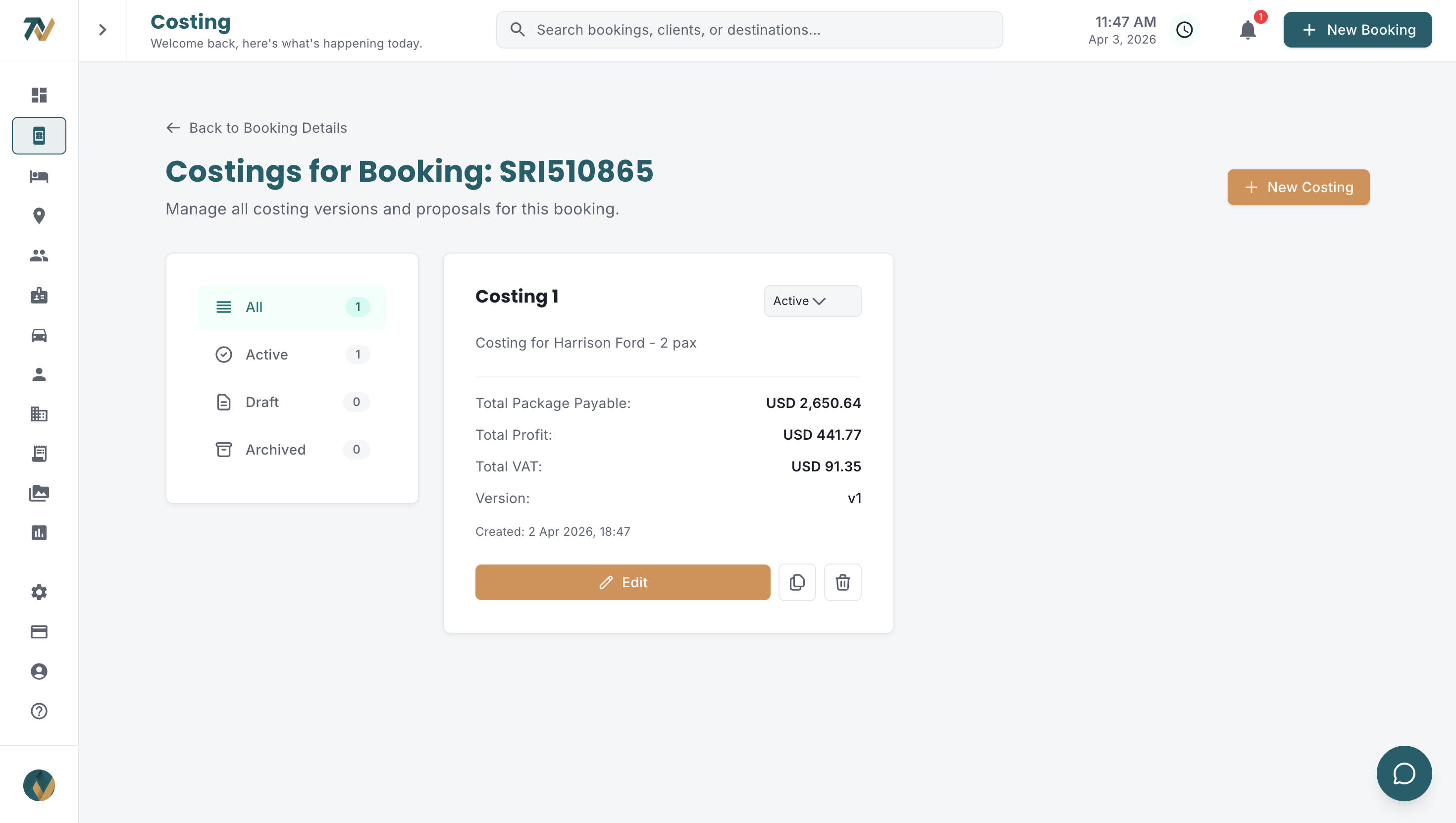
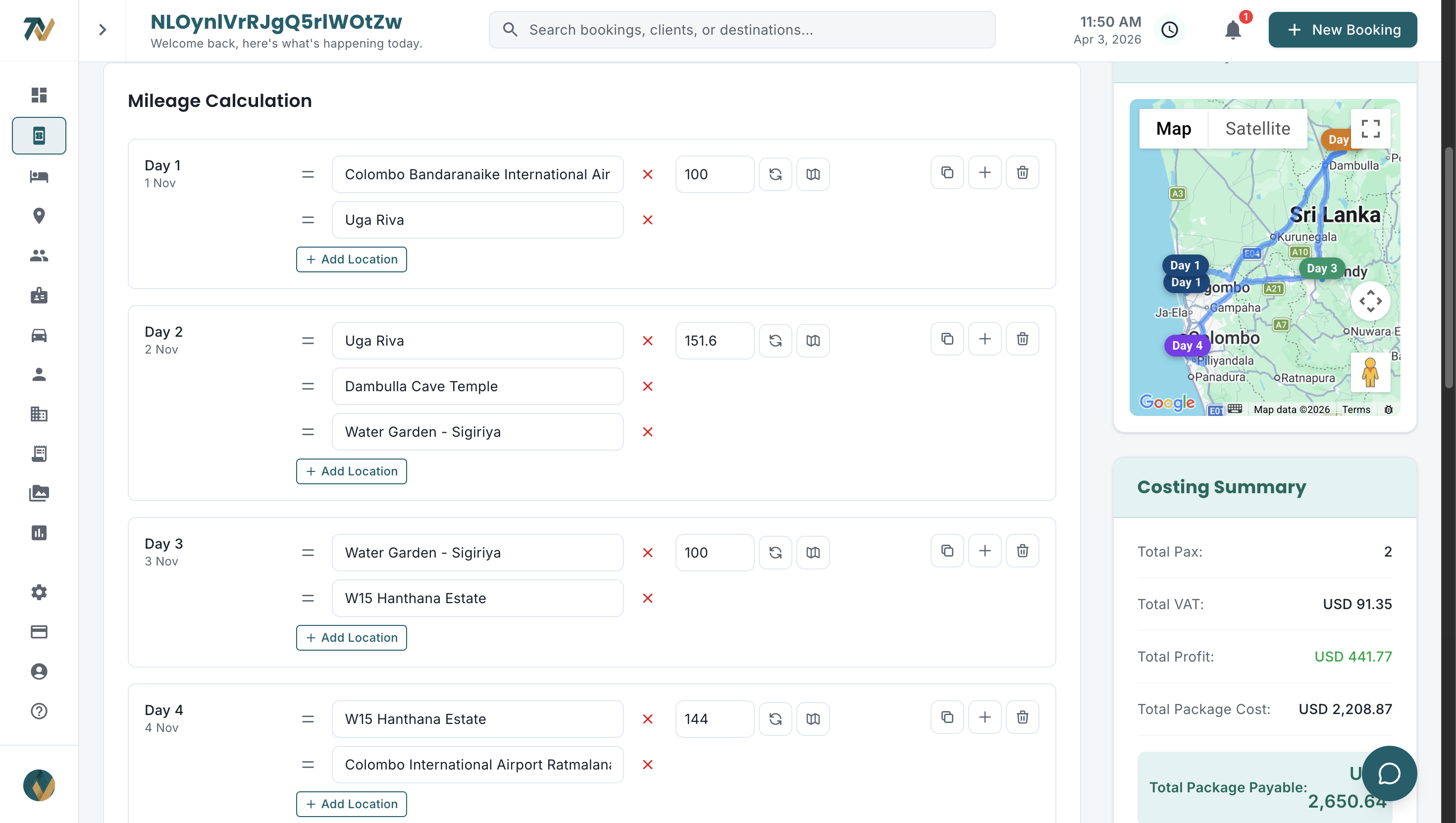
- Guided, structured costing. Transport (with automatic distance and mileage by vehicle type and configurable per-km rates), hotels (room types, meal plans, seasonal rates), guides, activities and other expenses are separate steps, so an empty category is visible before the quote goes out.
- Reusable expense catalog. Activity and expense templates, per person or per group, supply recurring items such as park entrances and airport transfers.
- Consistent pricing maths. Every cost is held in LKR, markup % and VAT are applied in one place, and a per-costing LKR to USD rate produces the USD selling price, so there is no manual conversion to get the wrong way round.
- Versions with one Active costing. Draft, Active and Archived versions keep an audit trail, only one version is Active at a time, a costing can be duplicated in one click, and team notes record why a change was made.
- Saved as you go. Edits in the costing editor are saved automatically in the background, and a status chip shows Saving and then Saved with the time; unsaved edits left from a closed session are offered for restore.
- Rate gaps flagged before they bite. The Procurement Rate Coverage grid highlights in red any month a live costing needs where the hotel has no rates, and contract or offer expiry warnings surface before an old rate sheet is reused.
- Settlement after every completed tour. A settlement is created automatically when a booking is marked Completed and tracks revenue against actual costs and payments, so planned margin and real profit can be compared booking by booking.
See how costing, procurement and finance fit together on the Travify solutions page, or compare plans on the pricing page. Every plan starts with a free trial.
Stop losing margin to preventable costing errors
Travify's structured costing, Rate Document Library and expense catalog remove the most common sources of tour costing errors, and settlement tracking shows the real profit on every completed tour.
Start your free trialarrow_forwardFrequently asked questions
Ready to Streamline Your Operations?
Join Sri Lankan travel companies already saving hours every week with Travify.
Related Articles
Tour Package Costing: Step-by-Step Guide for Sri Lankan DMCs
Every cost component of a Sri Lankan tour package, worked on a 7-night, 2-pax circuit: hotels, mileage, activities, guides, supplements, markup, VAT and currency conversion, with the formulas in the right order.
Hotel Rate Management for Sri Lankan DMCs: Fix the Chaos
If your hotel rates live in email inboxes, PDF attachments and WhatsApp threads, you are almost certainly quoting wrong prices. Here is how Sri Lankan DMCs centralise seasonal rates and stop the margin leak.
Tour Settlement and Profit Tracking for Sri Lankan DMCs
You quoted a healthy margin on a 10-day tour, but once the supplier invoices arrived the earned margin was lower. Per-booking settlement shows exactly which cost line took the difference.