
Multi-Currency Tour Pricing for Sri Lankan DMCs: LKR to USD
Costs in LKR, selling prices in USD: every stale rate, decimal slip and double conversion chips away at tour margins. A practical guide to one-rate-per-costing pricing for Sri Lankan DMCs.
Travify Team
Travel Operations Experts · April 13, 2026 · Updated October 6, 2026
In short: Sri Lankan DMCs pay hotels, guides and drivers in LKR but sell tours in USD, so every costing needs one exchange rate, applied once, at a single conversion point. Add a small buffer for the gap between quote and travel, update the rate on a schedule, set quote validity dates, and lock the rate per costing so historical quotes never drift.
A destination management company (DMC) is the local inbound tour operator that buys hotel rooms, vehicles, guides and activities on the ground and sells the finished tour to overseas travel agents. For a Sri Lankan DMC that means hotel bills, driver wages, guide fees and office costs arrive in Sri Lankan rupees (LKR), while quotations to agents in Europe, Australia, the Americas and India go out in US dollars (USD). Getting that conversion wrong costs real money.
The rupee has been volatile. Between 2022 and 2026 the LKR/USD rate swung from around 200 to over 370 and partly back. As an illustrative example, if a DMC priced a tour at $2,800 when the rate was LKR 320 per dollar and delivered it at LKR 305, its rupee costs became nearly 5% more expensive in dollar terms, enough to erase most of a modest markup.
Key takeaways
- Cost every tour in LKR and convert once, at one per-costing exchange rate, to a USD selling price; mixing conversion points creates rounding drift across the whole costing.
- Build a 1-3% buffer into the rate you cost with, scaled to how far ahead the tour departs.
- Update the house exchange rate on a fixed schedule (weekly, daily when the rupee is volatile) and make one person responsible for it.
- Put a validity period on every quotation so you can requote when an agent confirms weeks later at a different rate.
- Lock the rate on each costing version and compare quoted versus realised rates at settlement to learn what currency movement actually cost you.
- Travify stores one LKR-to-USD rate per costing and can show the traveller the itinerary price in their home currency at a rate frozen when you quote.
Where do multi-currency pricing errors happen in a DMC costing?
Currency-related margin leakage rarely comes from one big mistake. It comes from dozens of small inconsistencies across the costing process, and four of them account for most of the damage.
1. Inconsistent conversion points
Some designers convert each cost line from LKR to USD individually. Others total everything in LKR and convert once. Others mix, entering dollar-quoted hotels in USD and transport in LKR. Each method rounds differently, so the same tour produces three slightly different totals. Across dozens of bookings those rounding gaps add up, and nobody can reconcile them afterwards.
2. Stale exchange rates
The rate used in Monday's costing is not the rate that applies on Friday. A designer who forgets to update the rate in a spreadsheet, or types it from memory, introduces a silent error. If the rate moved 1% in the wrong direction, that is 1% off the margin on every costing built with the old number.
3. Decimal-place mistakes
Dividing LKR 485,000 by 320 gives $1,515.63. Type 3200 instead of 320 and you get $151.56; type 32 and you get $15,156.25. Manual conversion slips like these are most common under time pressure, typically during the December to March peak season when the team is racing to get quotations out.
4. Double conversion
Some hotels quote in USD. If a costing converts that USD rate into LKR at one rate and later converts the total back to USD at another, two conversion steps have been introduced where none were needed. With one rate for the whole costing a dollar-quoted hotel round-trips cleanly; with two rates it never does.
Illustrative example: a 2% conversion error on a $4,000 package is $80. For a DMC handling 50 bookings a month where half carry some inconsistency, that is roughly $2,000 a month, or $24,000 a year, of margin that nobody is tracking.
How does exchange-rate movement between quote and travel affect tour margins?
Exchange-rate risk is the structural exposure a DMC carries between quoting a USD price and paying LKR suppliers weeks or months later. For advance bookings that gap runs from two weeks to six months, and the rate can move materially in either direction during it.
| Scenario (illustrative) | Quote rate (LKR per $) | Delivery rate (LKR per $) | Effect on a $3,000 tour |
|---|---|---|---|
| LKR strengthens 3% | 320 | 310 | Costs rise ~$97 (margin squeezed) |
| LKR strengthens 5% | 320 | 304 | Costs rise ~$158 (margin nearly gone) |
| LKR weakens 3% | 320 | 330 | Costs drop ~$91 (unexpected profit) |
| LKR weakens 5% | 320 | 336 | Costs drop ~$143 (windfall) |
The impact is not symmetrical in business terms. When the rupee strengthens (fewer rupees per dollar), LKR costs become more expensive in dollar terms and the margin is squeezed. When it weakens, the DMC gets a windfall. Since nobody can predict the direction, the only lever a DMC controls is its exposure.
How can a Sri Lankan DMC manage exchange-rate risk without hedging?
A DMC can remove most of its currency exposure with four operational habits and no financial instruments: a rate buffer, scheduled rate updates, USD contracts with key hotels, and quote validity periods.
Build a rate buffer into every costing
Cost with a rate 1-3% less favourable than the market. If the market is LKR 320 per dollar, cost at LKR 315. The buffer absorbs minor movements without visibly inflating the selling price. Scale it with lead time: around 1% for tours departing within 30 days, 2-3% for tours three to six months out.
Update the house rate on a schedule
Review the conversion rate at least weekly, and daily during volatile periods. A stale rate is worse than a slightly imprecise one because it compounds across every costing that uses it. Name one person as owner of the rate and make the update a fixed part of their routine.
Negotiate USD contract rates with key hotels
For the ten to fifteen most-used hotels, contract in USD. This moves the currency risk to the hotel and removes the conversion step from the largest cost component. Many Sri Lankan hotels already offer USD contract rates to DMCs. Keeping those contracts findable is a separate problem, covered in hotel rate management chaos.
Put a validity period on every quotation
State it plainly: "This pricing is valid for 7 days from the date of quotation." If the agent takes three weeks to confirm, the DMC has the right to requote at the current rate. This is standard practice in inbound tourism and travel agents expect it.
After each tour is completed, compare the rate used in the costing with the rate at which payment was received and suppliers were paid. Over a season this shows whether the buffer is adequate, too aggressive or too conservative. Without that comparison a DMC has no way of knowing what currency movement is really costing it. The natural place to record it is the settlement, where revenue is reconciled against actual costs.
How should a costing handle hotels that quote in different currencies?
Pick one cost base (LKR), one conversion point, and record each hotel's invoicing currency next to its rate. On a single itinerary a Colombo city hotel may quote in USD, a boutique property in Ella in LKR, and a Kandy chain hotel in both while expecting payment in LKR. The costing has to treat each correctly:
- Hotels quoting in LKR: enter the LKR rate; it converts at the costing's buffered rate like every other line.
- Hotels quoting in USD: bring the rate into the LKR cost base at the same costing rate, so the line round-trips back to USD unchanged, and note the invoicing currency for settlement.
- Hotels quoting in EUR or GBP: convert to USD at the market cross-rate first, then treat the hotel as USD-quoted.
- Hotels with dual-currency invoicing: choose whichever currency gives the lower cost and record which one applies, so Finance pays the right amount.
In a spreadsheet this mix is a recipe for errors: some cells in LKR, some in USD, and formulas that assume one currency throughout. One unconverted cell throws off the whole costing, which is one of the reasons Excel is killing your tour costing.
Should VAT be applied before or after currency conversion?
Apply VAT last, on the selling price, in the selling currency. Value added tax calculated on the LKR cost price, or before markup, produces the wrong tax figure. The correct sequence is:
- Total all costs in LKR (hotels, transport, guides, activities, other expenses).
- Convert the total to USD at the costing's single rate.
- Apply markup to get the pre-tax selling price in USD.
- Apply VAT to that USD selling price.
- Present the agent with one USD figure inclusive of markup and VAT.
Getting this order wrong is a compliance issue as well as a margin issue. For the full markup and VAT walkthrough, read the complete guide to tour package costing.
Most DMCs keep USD as the house selling currency. When a European agent asks for EUR, the cleanest approach is to convert the finished USD price for display rather than maintain a second cost base: the cost side stays in LKR and the arithmetic stays in one place.
How do you keep 2, 4 and 6 pax price tiers consistent across currencies?
Use one exchange rate for every tier. When a DMC presents pricing for 2, 4 and 6 pax (passengers), the per-person price must be converted at the same rate across all tiers; otherwise the apparent group discount reflects rate differences rather than genuine economies of scale. The illustrative table below uses a single rate throughout.
| Cost component (illustrative) | 2 pax total | 4 pax total | 6 pax total |
|---|---|---|---|
| Accommodation (rooms) | $1,470 (2 rooms) | $1,470 (2 rooms) | $2,205 (3 rooms) |
| Transport | $200 | $260 (van) | $260 (van) |
| Activities (mixed per-pax/group) | $340 | $580 | $820 |
| Guide fee | $400 | $400 | $400 |
| Total cost (USD) | $2,410 | $2,710 | $3,685 |
| Per person cost | $1,205 | $678 | $614 |
| After 20% markup, per person | $1,446 | $813 | $737 |
The per-person price falls sharply as the group grows because transport and guide fees are fixed costs shared among more travellers. This is exactly the tiered pricing agents expect, and it only means something when a single rate sits underneath it. For positioning those tiers against competitors, see how to price tour packages competitively.
Set the exchange rate when the costing is created and leave it locked. If the rate needs to change because time has passed or the market has moved materially, create a new costing version rather than editing the rate on the existing one. The audit trail survives, and an accidental edit cannot silently distort a historical quote.
How Travify handles LKR costs and USD selling prices
Travify is built around the cost-in-LKR, sell-in-USD model described above rather than a general multi-currency ledger. Hotel, transport and guide costs in a costing are recorded in LKR and converted once, at a rate stored on that costing, into the USD selling price.
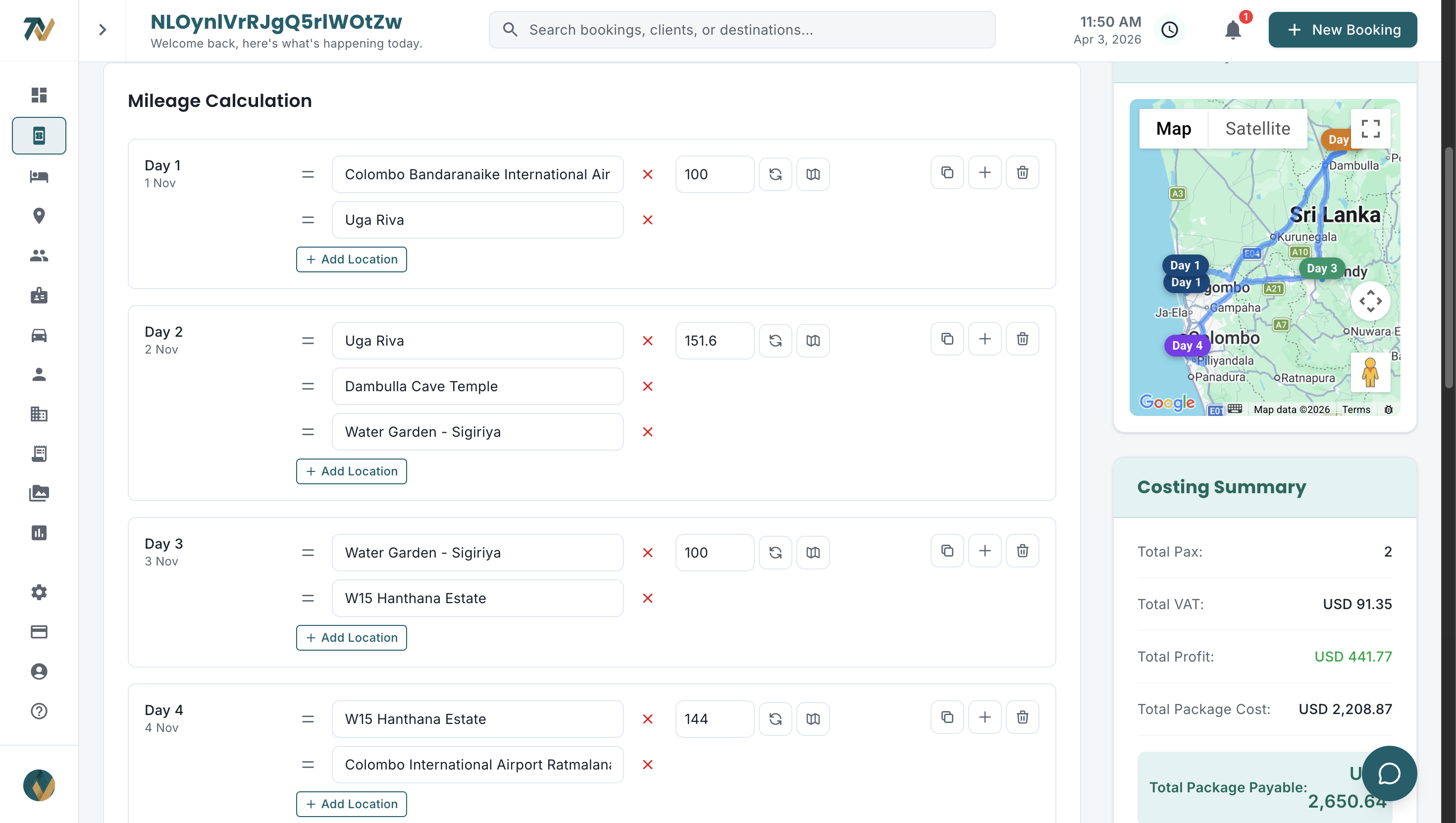
- One rate per costing: each costing carries its own LKR-to-USD rate, so a quotation built in January keeps January's rate after the house rate moves. Two costings on the same booking can use different rates if they were built at different times.
- Single conversion point: hotels, transport and guide daily rates are held in LKR and converted together at the costing's rate, which removes the conversion errors described above. Activity, entrance and other-expense lines can be entered in LKR or USD using the currency selector next to the unit cost; a USD line is added to the final price as entered rather than put through the exchange rate, so a dollar-quoted cost is never converted twice, and a line picked from the expense catalog takes the item's currency.
- Markup, VAT and VAT method on the costing: markup % and VAT % are set on the costing alongside the exchange rate rather than re-typed into each spreadsheet. The VAT method is a company setting with three options, VAT on costs only, VAT on costs and profit, or VAT on the selling price, and each costing carries the method frozen when it was created, so existing costings keep theirs when an admin changes the setting.
- Duplicate for pax tiers: duplicating a costing in one click copies its rate, so 2, 4 and 6 pax versions compare like for like.
- Draft, Active and Archived versions: changing the rate means a new version; only one version is Active at a time and the earlier one stays on file.
- Client home-currency display: the shared itinerary can show the traveller the price in their own currency at a rate frozen on the costing.
Showing the traveller a price in their home currency
The currency a DMC invoices the agent in is not the currency the traveller thinks in. A German family looking at a USD package has to do mental arithmetic before judging value, and that friction works against conversion.
Travify handles this with a converter on the costing's Final Pricing step. The client currency is picked automatically from the booking's client country and can be changed, the rate (1 USD to the client currency) can be fetched live or typed by hand, and it is saved on the costing at quote time so the price does not drift with the market. "Show in itinerary" tick boxes choose whether the total package price and the per-room-group prices show USD, the client currency or both, and in the itinerary builder each room group has its own client-currency toggle. The converted figure then appears next to the USD price on the shared itinerary link and in the itinerary's PDF download, and because the rate is frozen on the costing it does not move after the itinerary is sent.
Explore the full costing workflow on the solutions page, or compare plans on the pricing page; every plan starts with a free trial.
Stop losing margins to currency errors
Travify keeps every cost in LKR, converts once at a rate locked to the costing, and shows the traveller a home-currency price frozen when you quote. Start your free trial today.
Start Free Trialarrow_forwardFrequently asked questions
Ready to Streamline Your Operations?
Join Sri Lankan travel companies already saving hours every week with Travify.
Related Articles
How to Price Tour Packages Competitively and Protect Margin
Price pressure and rising costs are squeezing Sri Lankan DMC margins. Six practical pricing strategies, from accurate costing to settlement checks, that win bookings without giving away profit.
Tour Package Costing: Step-by-Step Guide for Sri Lankan DMCs
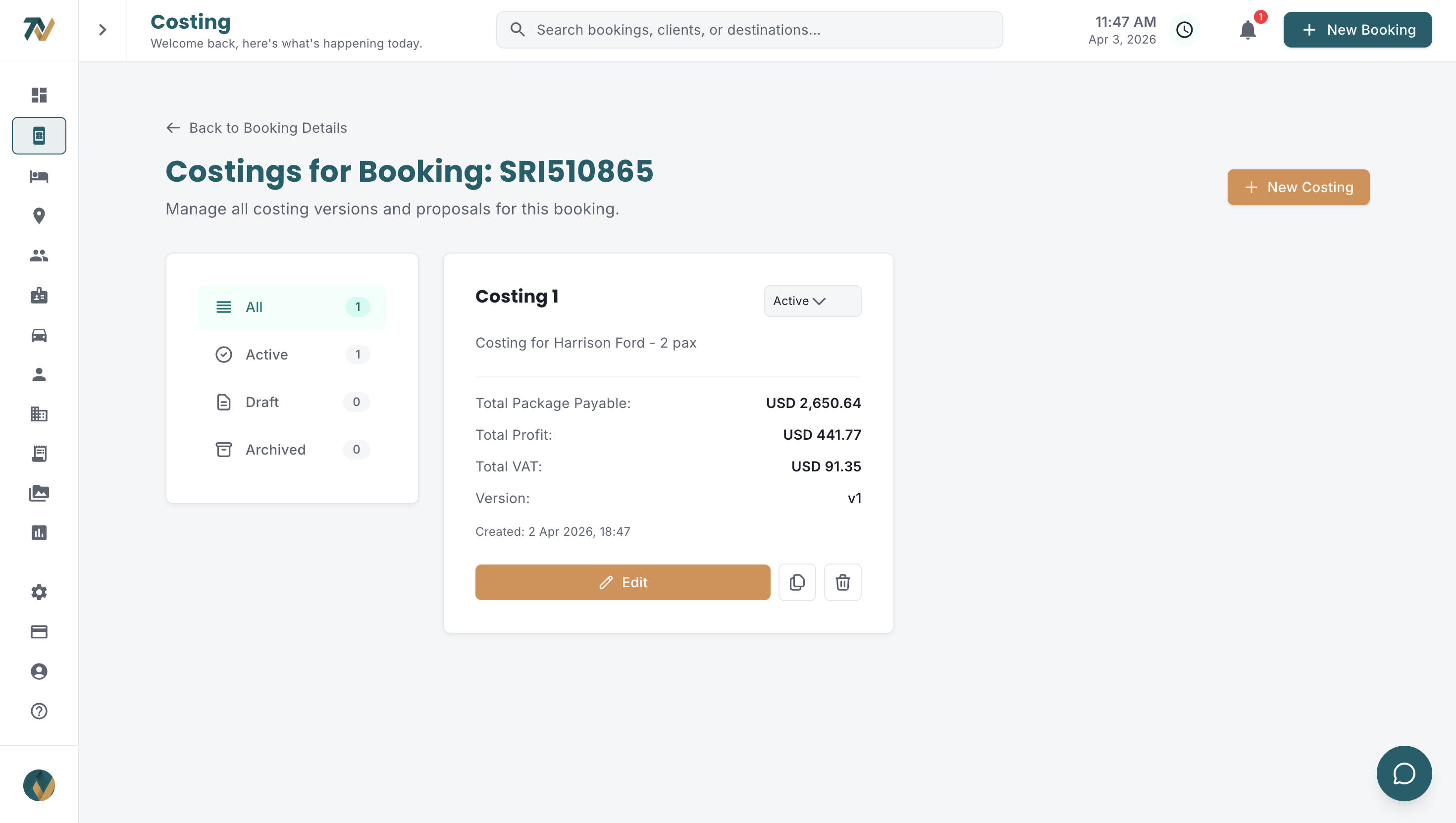
Every cost component of a Sri Lankan tour package, worked on a 7-night, 2-pax circuit: hotels, mileage, activities, guides, supplements, markup, VAT and currency conversion, with the formulas in the right order.
Tour Settlement and Profit Tracking for Sri Lankan DMCs
You quoted a healthy margin on a 10-day tour, but once the supplier invoices arrived the earned margin was lower. Per-booking settlement shows exactly which cost line took the difference.